Showing posts with label Spy. Show all posts

Thursday, 22 September 2022

Article: Refrigerator Prize


By Leslie Byron Pitt

The best thing that Charlie’s Angels (2000) did for me was introducing me to Sam Rockwell. I had seen him in films before McG’s sugary gloss fest for sure. He was fun in Galaxy Quest (1999), intense in The Green Mile (1999) and I’m sure he knocked it out of the park as “Head Thug” in the Teenage Mutant Ninja Turtles movie (1990). I don’t remember. I’ve only seen that film once over 20 years ago. I was more of a Secret of the Ooze guy. I digress. It was Rockwell’s performance as Tech Nerd/Draw Barrymore’s love interest Eric Knox that grabbed my attention.  Moreover, it was his shimmying and shuffling to Pharaoh Monche’s Simon Says after becoming a turncoat to the angels and dear old Drew which piqued my interest. It was suave villainy that was not only enjoyable for the outlandish movie it appeared in. It deserved to be in a better movie. The kind of movie moment which convinces an impressionable young mind to track this actor and see whatever film they might be in next.

The next notable performance for Rockwell was Welcome to Collingwood (2002) directed by Marvel stalwarts The Russo Brothers. A film which had desires to be Coen-like and ended up being mildly enjoyable yet wholly forgettable. Collingwood teamed Rockwell up with George Clooney who soon embarked on his directorial career with Confessions of a Dangerous Mind, released in the same year. I was fortunate enough to catch both movies at the UCI cinema where I worked. At the time, the cinema had a weekly slot named “The Director’s Chair” in which films, both old and new, which were worlds apart from things like Charlie’s Angels, were allowed one showing for supposedly more discerning cineastes. Collingwood faded from my mind quicker than the running time of its end credits. Confessions of a Dangerous Mind, however, bored me. Still perhaps Clooney’s most interesting directorial feature, the film solidified Rockwell as a preferred performer of mine. His freewheeling performance is still a notable turn in my cinema-going. The film itself I still consider one of my favourites.

The story of Confessions of Dangerous Mind is the semi-autobiographical, fully bat-crap crazy memoir of one Chuck Barris (Rockwell). Known to American audiences as the creator of The Dating Game (U.K folk, think Blind Date) and The Gong Show. Barris was a multi-faceted performer and producer who did everything from hosting the shows he produced to writing hit pop songs. What his cult autobiography reveals however is that he also led a double life as a C.I.A operative. Utilising his hit T.V show as cover, he moonlighted as a hitman for his country. So, he says.

David O Russell allegedly turned down the chance to direct Confessions saying that the film was “just not about anything but a guy who liked to fuck girls and say that he shot people in the head." It’s slightly amusing that Clooney, who had an altercation with O Russell on the set of Three Kings (1999) due to his treatment of cast and crew, clearly saw something within the story and picked it up as his debut feature. Clooney doesn’t do anything too radical in terms of insight. At the base level, Barris is a man who is struggling with his feelings of inferiority. However, Confessions of a Dangerous mind still stands out as Clooney's most playful movie since he moved into directing. It’s hard not to sense a feeling of mimicry when watching Confessions. There’s Coen-lite energy to things. Something that makes sense given Clooney’s then-recent collaborations. Yet Clooney’s indulgent decision to overload the movie with a flurry of visual flourishes is not just a sign of the first-time director revelling in the creative sandbox. Even now it still feels like the last time Clooney let loose behind the camera.

Confessions is less engaged with its directors’ political leanings, yet much like Clooney’s sophomore effort Good Night and Good Luck (2005), the film delves into a period when television rubbed up against communist ideals. Good Night and Good Luck stoically focuses on McCarthyism and press freedom.  Confessions toys with the idea that gains could be made in the cold war via the host of The Dating Game shooting agents in the face while acting as a chaperone for his unwitting contestants.  Both films utilise American TV as an instrument to either reflect or neglect the fear and paranoia the American people had with communism. Albeit Confessions stays broadly focused on Barris’ sexual and mental fragility, with the Cold War as a side dish
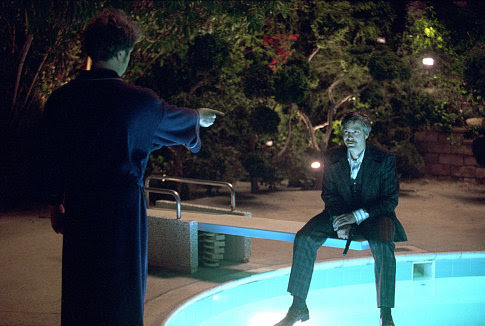

The Barris story's madness and what could be Clooney’s naivety behind the camera instead of in front of it allow the Ocean’s 11 star to deliver a film that is off the chain with visual “moments”. A Delightfully assured tracking shot has Barris touring the halls of NBC only to be the host of the same tour an instant later. Meanwhile briskly cold silhouettes situate the frosty European countries that the TV presenter must navigate to find his targets. When time allows Clooney slots, Rockwell, in front of mirrors to implicate the duplicity. That’s not when he’s having telephone calls meld into the same location or having C.I.A agents bleed artfully into swimming pools while sitting on diving boards.  A late sequence has Barris having a mental breakdown in front of an imagined slaughtered audience. A terrifying vision of a CIA hitman losing the plot? Or are we watching a deeply troubled producer seeing his brain-dead shows kill off the smarts of the audience? This is contrasted with an earlier scene in which a desperate Barris sits in a full auditorium glumly watching a movie while everyone around him is kissing. When Barris meets the free-spirited love interest Penny (An enjoyable Drew Barrymore), they’re seen necking in the theatre while everyone watches the movie intently. Seems that ol' Chuck never seems to fit in with the crowd. So why not envision them dead? It’s a moment which feels strangely apt for such a cracked mind. All this is delivered with a brightly lit retro colour palette and a wink to his usual collaborators. Blink and you’ll miss some friends of Clooney’s looking flummoxed on the dating game.

It's no surprise that it can all feel a bit much for some. Maybe a feeling of Clooney enjoying himself a copious amount. The film’s screenplay was written by Charlie Kauffman, the misanthropic creator of such gems as Synecdoche, New York (2008), and I’m Thinking of Ending Things (2020). Two incredibly cynical mind benders. Kauffman has stated his frustration with the finished film, with talk of a drug addiction subplot excised from the final film. Confessions is all a bit too sprightly for the dark trappings that inhabit most of Kaufman’s work. The screenwriter highlighted that this was more of a script on order, which had lounged in development hell for years than anything else. Jumping from director to director before finally landing on Clooney’s lap. As accomplished as Kaufman’s creations usually are, this is far from his more sardonic imaginings. And considering the grimness which inhabited I’m Thinking of Ending Things, that’s perhaps for the best.

Weirdly enough, Confessions still has enough Kaufman DNA inhabiting it to remind you of the scribe. This is a film about a self-loathing white male talent, wracked with self-doubt despite his success. This of course runs through the likes of Adaptation (2002) and Synecdoche, New York (2008). Although what’s perhaps lacking in this over the likes of films such as Being John Malkovich (1999), Eternal Sunshine of the Spotless Mind (2004), and Anomalisa (2015) is the element of communication breakdown between the film’s lead and everyone around them. If anything, Chuck Barris is a superb communicator. With the likes of Dick Clark leading the famous parade of known talking heads informing us of Chuck’s brilliance. Barris perhaps has too keen an ear on what the people want. His shows are not only still being observed in similar ways today, but also seem to be the type of “low culture trash” that can draw in huge crowds. The Gong Show feels no different from the most popular element of X-Factor. Praying on normal people who seek attention, despite maybe not having the inherent media talent for true success.

“…To mock some poor, lonely people who just crave a little attention in their lives. To destroy them. So everybody’s not brilliantly talented. They’re still people. They deserve respect and compassion. I mean, who the hell are you? What the fuck have you ever done that elevates you above the pathetic masses? Oh, I forgot, you created “The Dating Game”. Wow, right up there with the Sistine Chapel.”  - Pretty Woman

This quote is perhaps the most stinging moment of the film. And perhaps one of the most crucial. A withering blow to the strutting male ego. A beautiful, unknown woman dissecting Barris for what he is. Suddenly no matter how often we frequent Barris’ more dangerous alternative life, this woman’s burning critique feels seared onto Barris like a branded cow.  This is a man who wished he was more than what he became. Even when at the point of success, he is haunted by what could be considered imposter syndrome. George Clooney is interested in the moment where media & politics collide. But that truly comes later. In Confessions, this is the filmmaker going down a road well-travelled. That of a mad male talent and his demons. Is Barris telling the truth? The answer perhaps lies in how much you feel about appealing to the lowest common denominator and when you’re called out on it.  The film ends with perhaps one of my favourite quotes as the actual Barris is sat down, much like the docu-style talking heads from earlier. The lighting is harsh and bright. Blasting out any wrinkle or detail. The final moments are as earnest as they are depressing. Barris’ last quote is as follows:

"I came up with a new game-show idea recently. It's called The Old Game. You got three old guys with loaded guns onstage. They look back at their lives, see who they were, what they accomplished, how close they came to realizing their dreams. The winner is the one who doesn't blow his brains out. He gets a refrigerator."

I think it tells us all we need to know.


Confessions of a Dangerous Mind is on various streaming platforms. I dug out an old DVD.

Dug what you read? Buy me a Ko-fi!


Friday, 31 January 2014

Review: Jack Ryan: Shadow Recruit

Year: 2014
Director: Kenneth Branagh  
Screenplay: Adam Cozard, David Koepp
Starring: Chris Pine, Kenneth Branagh, Kevin Costner, Keira Knightly

Synopsis is here:

I’m guessing some people are considering Jack Ryan: Shadow Recruit as a return to the old school. Well, fair play to them. Despite what my friends sometimes think, I do like to take in the thoughts of others. However when it comes to my view on the film (which I keep calling it Shadow Agent, such is the generic title), I found it to be a cornucopia of cliché which will most likely be forgotten in a blink of an eye. Then again that’s what people want right? How dare people have high expectations for a spy thriller. They should be farted out with no distinction at all, right?

Jack Ryan may have nabbed a little from  the likes of Bourne, but it’s taken a lot more from older, more typical spy jaunts. You can see this by the vast amount of times super secret items are passed covertly between people. If you were to make this a drinking game, you could be so inebriated that you’d forget the first 2 acts.

Then again, Jack Ryan: Shadow Recruit also struggles with the idea of lasting effects.  Our dear Mr Branagh may state that Chris Pine’s Jack is no superhero, but trust me we get a Jack Ryan who performs near impossible feats with a near broken back and is hopping skipping and jumping better than Mario during a Bowser level. Emotional depth fares no better, but then again the limp arguments that Ryan (a spirited but slumming Pine) faces with his wife Cathy (an anonymous Knightly) come across as vague and ineffectual despite their intent.        

The only thing that remains in the mind is the idea that it’ll be those nasty Russians that will cause America’s “2nd Great Depression”. After watching how Wolf of Wall Street dissect the type of near psychotic excess that help take a dent out the western world from within, to state that it’s those pesky Red’s who be causing financial grief because of cold war flash backs, seems more than a little rich.

Sparring with the old enemy may be the only thing to spark interest in a film which is dedicated to keeping one foot in the grave, but the cold war memories also hint the issue with not only Jack Ryan, but one or two of the more recent entries of the spy genre. Do we really need a Jack Ryan now?  A spy all jazzed up for a younger audience who probably have little care for the Cold War? While an older audience may have the knowledge to check out older features that don’t seem so slight and forgettable?

The film’s disappointing box office has still managed limp into the black, so it won’t surprise me if we see another entry in the Jack Ryan series. Although money made doesn’t mean movie enjoyed, there appears to be enough greenbacks behind this to nudge an executive into action. I’m guessing I’m once again in the minority asking why. 

Saturday, 27 October 2012

Review: Skyfall

Year: 2012
Director: Sam Mendes
Screenplay: John Logan Neal Purvis, Robert Wade
Starring: Daniel Craig, Javier Bardem, Judi Dench, Ben Whishaw, Ralph Fiennes, Naomie Harris, Bérénice Marlohe, Albert Finney

Synopsis is here:

NOTE: I do not give explicit spoilers, but this review may not be great for anyone who wants to know anything about the film (although nearly everyone has seen it by now)

Skyfall is the film which celebrates 50 years of the character, appearing in features. Starting from Dr No in 1962 to the present day, Bond has drank, shagged and shot his way through five decades and remained something of an institution of British culture despite a barrage of ever-changing constituents. Add to this that cinema itself is not even 150 years old itself, Bond's longevity is something to behold. Bond’s near rampant alcoholism and misogyny apparently meaning nothing to his stout love for country. Maybe it's just the franchise's incredible ability to make things blow up extraordinarily, that keeps many chomping at the bit.

The most recent interpretation of Bond, has held some of the most radical alterations to the character since its sixties incarnation. Daniel Craig's Bond is a subject of grief, pain and retrospect. Even the rushed, muddled shenanigans of Quantum of Solace (maybe the only person in the world who doesn't mind it) reminds us that the brash, blunt instrument is someone motivated by murky emotions. James may be "doing it for England" but it's clear that he is heavily motivated by his relationships and those that he has lost around him.

Film critic for The Independent; Anthony Quinn, doesn't have much of an affinity for this more affected, softer Bond that's been on display, and it's understandable. There's a strong feeling that the Bond of the old guard is slowly evaporating. The character's mystique ebbing away; due outside wishes to be a little bit more like the Bourne franchise. The mythos is a sacred one, just look what happened when Mutt was introduced to the Indy mold.

Yet, here with Skyfall, I found myself invested with the ideas and themes that are at play. Here we have a more traditional spy caught in an era of transparency and internal conflict. Skyfall is smart enough to move with the times and ground an iconic hero with a certain amount of "plausibility" (we'll use this term very loosely). But it also caters to other aspects of the character that has made him so durable. It doesn't all work. The lack of camp humour has made the jokes and jibes dryer than a Chardonnay in the Sahara. Also, Skyfall still has difficulty with how it wishes to place certain females in the frame, trading off a well written a solid performance of Dame Judy Dench's M, for what can almost be considered as almost Bond girls. I have no real problem with Naomie Harris or Bérénice Marlohe in terms of their acting. However, they happen to be two of the more forgettable elements of the feature. At no point are we given the same sizzling interplay that makes Eva Green's Vesper Lynd so beguiling.

Nevertheless, Skyfall, for me, is the strongest of the Craig Bond features.  Swift with its pace and high on its octane levels, the film rarely drops a gear, nor loses focus. As an action film, the film hits all the beats with a satisfying crunch. Unlike the haphazard Quantum of Solace, Sam Mendes dictates the film with an actual rhythm for the audience to follow. He also gives us set pieces that just feel right for the occasion. Commandeering a Caterpillar and taking out VW Beetles? A dazzling, silhouetted fist fight in a Shanghi high rise? Kicking ass in-front of Komodo Dragons? Moments like these fit Bond to a tee.

As many have said, the film's real star may not be the intense, brooding Craig, but actually, cinematographer Roger Deakins. Mendes and Deakins work together, not only to make Britain itself an exotic place of its own accord (with Bond travelling all over the world, the U.K should feel strange to him) but also shape Britain as a visual metaphor for Bond himself. If the damaged MI6 building in London is where James' heart lies, it's no surprise that Skyfall, located in the Scottish Highlands is where his head is at. Deakins' creates a perfect storm of murky gloom. Such ambivalence is needed in the aesthetic to help continue a through line created since the Casino Royale reboot, that this a Bond conflicted internally by hurt. Some may not want such an understanding of 007, but the idea that the ability to inflict so much damage comes from a certain form of affliction (orphans make the best spies) is a decent way to keep the character fresh.

Deakins works his magic in wondrous ways, producing one of the most memorable introductions to a Bond villain that I can remember. For all the Brit-centric elements of the film, the first appearance of Raoul Silva on his creepily deserted island makes a grand impression. As the rouge net nerd, Silva, he struts between rows of modems and servers.  We notice that his savvy for modern tech is the perfect contrast towards Bond's staunch, last Bastille of traditionalist Britain. Bardem hits the ground running, allowing his flamboyant performance to tie up with the scene. He is the antithesis of Bond. His ambiguous sexual advance towards Bond at one point only helps suggest that this new world of villainy doesn't adhere to the same straight edged rules, we've known from before.

Themes like these are what Skyfall is about at its heart. I'm fascinated with how certain roles of traditionalism play off in a world that is shedding many of those features. A good chunk of the film belongs to Dench as M, who herself is trying to figure out what place she as well as Bond has in a changing regime. A pivotal and tense court room set piece sums up her feelings eloquently.

Skyfall comes out of the box strong, delivering high impact thrills and now a fully updated Bond that many can get their teeth into. Grumblings about Connery being the best will never go, and those complaining about a Spanish agent spying in Hong Kong for the Brits during the handover, may possibly be looking a tad too deeply into things. For me, Skyfall was the type of solid summer popcorn film, which ironically, due to tradition, missed its season.

Sunday, 19 August 2012

Review: The Bourne Legacy

Year: 2012
Director: Tony Gilroy
Screenplay: Tony Gilroy, Dan Gilroy
Starring: Jeremy Renner, Rachel Weisz, Edward Norton

Synopsis is here

My problem with The Bourne Legacy is that it's so interested in it's lofty themes, it completely forgets about getting the basics down. There's a kernel of a decent film which is lost amid a pool of lacklustre motivation, uninteresting characters and bland story. All that isn't supposed to matter because GUNFIGHTS AND CHASES. Unfortunately; we've seen all that before, with the first three Bourne films. Those films also had the decency to give you something tangible to hold on to while you rode the roller-coaster.

As I said before there are a few points of interest within The Bourne Legacy. One of them is the idea of soldiers being created with less remorse, making them more efficient killers in the field while losing the compassion that compasses their humanity. The film references this twice. Firstly; when a our new Jason Bourne, Alex Cross (Renner) meets another agent at a remote outpost, sent there because he "fell in love". Secondly in a admittedly impressive motorcycle chase sequence, an enemy agent grunt who is "tradestone with none of the inconsistency, appears and goes Terminator on our heroes. The idea that the genetic science that may have created Jason Bourne is now being used to zone out emotional capacities is something I would find fascinating in a movie, particularly in one like this in which does show some promise with dialogue that doesn't feel like it's been processed for teenagers. Placing a pharmaceutical company the way the film does as the antagonist also gives the film a 70's thriller vibe and maturity that you may not get with your vampire hunters or even Avengers.

Problems arises however, when you realise that Alex Cross is just not Jason Bourne and the so called legacy looms large over the entire project. We are told every early on by an uninterested Edward Norton, to forget about Jason Bourne. But Bourne's search for his identity (as well as his humanity) give him a clear purpose. Here; we're given a bland goal of having to get "chems" or else. This wouldn't be a problem if Cross was a character worth following. The same goes for the antagonists chasing him down. There seems to be little at stake for everyone involved. Whatever stake that is negated, doesn't feel worth bothering about.

The film doesn't make good on its terms, starting very slowly, almost to the point of tedium, before wandering aimlessly (the middle being punctuated with well structured but ultimately meaningless action set pieces) and finishing abruptly, with the main narrative being nowhere as interesting as the subtext the film mentioned. Renner and Weisz sell their roles well but I found myself constantly arguing the point of the whole thing with myself. When you do that, your not enjoying the movie.

Thursday, 26 January 2012

Review: Haywire

Year: 2012
Director: Steven Sodenbergh
Screenplay: Lem Dobbs
Starring: Gina Carano, Micheal Douglas, Ewan McGregor, Micheal Fassbender, Antonio Banderas

Synopsis is here:

Haywire is a film, which I found easier to like more than love. I can sense that many; expecting something a little more conventional, will find it extremely easy to hate. But let me say one thing, it's a Steven Sodenbergh film, one should expect something a little different. Take away those Ocean films and even his more mainstream features still can feel like a round peg in a square hole. Despite how that sounds, I do mean that is a good way.

Lean, mean and tightly crafted, Haywire is a volatile piece that doesn't outstay it's welcome. During it's stay however, we do get to jump and jetset around a variety of different locales to a retro 60's David Arnold soundtrack. All this while we follow Mallory, an ex-marine cum private sector special trying to find out (violently) who double crossed her, during her last job and why. To quote Bad Boys 2: "shit just got real".

Looking for anything too in-depth in a film like this; is much like eating a dry cracker to rehydrate yourself. My second paragraph has told you nearly everything that happens within the movie. This comes at a price however as the film does hit anything past the superficial. The film just doesn't give us enough to get a hold of. I found myself comparing the film to The Limey (also scripted by Lem Dobbs), a genre exercise which is equally as straight edged as this. However, despite Sodenbergh's 1999 feature being more experimental than this (non liner editing and the like), it still manages to have a solid emotional centre through Terrence Stamp's amusing yet strikingly sad performance.

The only strikes that land here are from the fists of the hard hitting Gina Carano whose one note performance is understandable considering the tightness of the script and lack of acting experience but struggles if the film even sniffed at trying to hit a station above ass kicking. The story is very typical spy affair, while it's difficult to find anything within the character of Mallory that stands out other than the obvious.

Is the first time casting of the MMA/Former American Gladiator a piece of stunt casting? Yes and No. In comparison to the likes of Brittany Spears (Crossroads), Christina Aguilera (Burlesque) or Mariah Carey (Glitter) Carano has not got the inbuilt fan-base to lie back on, nor does it feel like an expansion of a brand (although considering her maxim spread I may be wrong). Carano has a certain look and build that fits the character she plays. Having an known actress could have been distracting, particularly as the fight scenes are edited and shot in such a way to emphasise Carano's talents. However Gina is no Thespian and it shows, making it feel at times that Sodenbergh hired her because, why not? With this said, none of the acting really rises above a certain level.

Despite this the film is gorgeous to look at, happily hops from place to place in an amusing James Bond fashion and the fight sequences are expertly put together in long, unflinching, unbroken takes. There is a gimmicky feel to having Carano in the part but it is amazing to watch her in full flow. While the linked photoshoot may cause fapping within the teenage boy sector, Sodenbergh takes away the blatant sexuality. This gives us a character who can be looked at in the same way as any male figure if they were placed in the same position. It would be nice if the character, performance and story could catch up with the gender politics.

Note: Head to Movies.com for a an interesting article on Carano's role within the movie and in the action movie dynamic.

Friday, 16 September 2011

Review: Tinker Tailor Soldier Spy

Year: 2011
Director: Tomas Alfredson
Screenplay: Bridget O'Conner, Peter Straughan
Starring: Gary Oldman, Colin Firth, Tom Hardy, John Hurt, Toby Jones, Mark Strong, Benedict Cumberbatch

Synopsis is here:

At one point in the movie Kathy Burke's supporting character mentions that the second world war were happier times because at least then you were proud to be English. Burke's small almost throw away statement is one the solidarity she felt at the time of war, now lost due to an alleged mole at the head of the "circus" (MI6).  This for me is the crux of Tinker Tailor Solder Spy; a film which, almost ironically comes out at a peak of general mistrust from all around Britain.

This film adaptation of John La Carre's novel is a complex and complicated thriller, and what drives it isn't so much who the much talked about actually mole is (although I'm happy I didn't guess it straight away), but more on how loyalty is brought and corrupted. The film's seemingly low key climax is one that displays how far trust has been stretched for the wish for control. The film's final montage of the stellar cast (a beautiful mixture of both big and small screen actors) shows how deep the scars have been inflicted on these people.

Alfredson's film works so well because it take time over showing how deeply isolated the spy game is. Close relationships are broken, belittled and bargained for, information is called gold dust for good reason and moral compasses are as murky as the films cold, drab colour scheme that Alfredson utilises to enhance the tone of the film. The film is literally as grey as the the shades these characters dwell in.

Let's be very clear about this, this is no Bond or Bourne movie. The lines are never drawn out and the information we receive is drip feed to us. Alfredson demands that we hold attention for this movie and those who do will be rewarded. Dialouge is often coded and it's important to see the slight changes within a characters face rather than the words they speak. The film never speaks down to you, and Alfredson is happy to tell the films story within the visuals and the body language of the characters. The pinnacle of this lies in the performance of Gary Oldman who at 53 plays George Smiley as if he's at least 12 years older. We discover everything we need to know from the eyes behind the thickly rimmed spectacles. One of the films highlights is superbly crafted monologue by Oldman in which his brief meeting with the mysterious Karla highlights all the emotion the crackles beneath the surface. In watching the brief recollection we see that it's how the story is told (pinpointing the exact moments of loss both professionally and emotionally) that really makes what is said hit home as hard as it does.  The film is littered with such moments. Vast amounts of information communicated not by trite dialogue, but solemn glances and knowing looks.

I loved this movie not only because of its brilliant cast and delicately sombre tone, but its an eye for detail and a wish to let said details envelop around you. The film makes sure you know it's two hours long and makes sure that every character is accounted for. The depth we manage to gain from even one scene of some the supporting roles is at times astonishing. Those who rely on the summer sun blockbuster guns, girls and car chases will be sorely disappointed that Commissioner Gordon doesn't do any physical ass kicking here. But those looking for an adult feature will find much to gain from it. The paranoia lies within the characters as thickly as the dusty old rooms they inhabit. The relationships and trust these people have worked so hard to build is on a constant knife edge. Despite being a period piece (Early 70's) the understands that even now in the age of information it's all about holding the right cards. Everyone here has poker faces to die for.

Friday, 3 June 2011

X-Men: First Class

Year: 2011
Director: Matthew Vaughn
Screenplay: Ashley Miller, Zack Stentz, Jane Goldman, Matthew Vaughn
Starring: James McAvoy, Michael Fassbender, Kevin Bacon, Jennifer Lawrence

Synopsis is here


Here's a turn out for the books. The summer blockbuster I had some of the most doubts about, turns out to be mega high on the entertainment factor.  I had already been burnt from the last two features from this franchise (the very bland X-3 and the dubious Wolverine) so my interest in the mutant adventures had cooled. It didn't help matters that after two lacklustre endeavours as of late (Pirates and The Hangover 2), that were meant to ignite the summer season, that my interest in this (nee the series) had cooled somewhat.

X-Men: First Class impressed me however, by being a simple, by the book, adventure film. We root for these characters because of their actions on the screen, not because we know who they are. The action is relatively bloodless (12-A) but it's clear, concise and to the point. What's more; the pace is brisk (didn't feel like two hours) and while Vaughn doesn't fully get the balance quite right of all those characters in my opinion (I think X-2 does it better) he does make sure that the conflict is high and investment in these people worthwhile. Despite the film being a prequel, Vaughan's direction (along with a decent screenplay by the four writers) helps build a strong background for people that we already know and a new found interest in them.

The ideas of placing the X-men in the middle of the Cuban missile crisis works well on two fronts as it means that every human is under the threat of war, while radiation would only advance mutations in those in already already have them. It's a neat plot thread that the film runs with well, using Kevin Bacon to do his smarmy, slimy worst (great cast pick). It's odd that despite being set in the middle of the civil rights movement, the film does draw that much from it. One of the things that made X-2 what it was that the parallels between Malcom X (Magneto) and Martin Luther King (Professor X) appeared to be much stronger, however you could say that this is a film where such facets are just about to be defined.

While that particular outlook is sidelined, Vaughan still sets about creating a solid structure of core beliefs an intimate relationships between the two main characters of the piece; Eric (Fassbender) and Charles (McAvoy) and their outer circles. Seeing how these relationships come together is a pleasure as these mutants are thrown into an era of change while slowly discovering their own personalities. Vaughan doesn't appear to be as developed in the theme of finding identity as the openly gay Byran Singer and it shows when looking at singular scenes. But what Vaughan do manage to capture is a similar spirit that was gouged out by the recent entries before it. I like the idea of Mystique echoing Rouge somewhat. I also like the fact that the friendship between Erik and Charles is a fast one that isn't just out and out friendly or combative but balanced on the edge of something. A subtle knowing that something big could come from both of them.

A lot of this is not only stems from Vaughn and the screenwriters but from a bright young cast who are up to the challenge. Much could be said about the films stylish retro 60's era setting (and man from uncle/bond plot) but it's the cast that give the film it's true freshness. both McAvoy and Fessbender are charming in their own special way. McAvoy has a smart, Hugh Grant thing going on, while Fassbender as a James Dean like, devil may care feel that draws attention to him in every scene he's in. Both Jennifer Lawrence and Nicholas Hoult hit the akward teen stage on the head, while the aforementioned Bacon doesn't have as much screen time as I would like but is just the right side of nasty. January Jones and Rose Byrne are pretty thankless in their roles but both show enough skin to make the teen audience not notice anyhow. Vaughan also decides upon himself to load the film with some great character actor cameos (Ray Wise, Michael Ironside, Oliver Platt) just to keep things ticking over as if his efficient use of pacing in the movie wasn't enough.

But what the main reason on why people will watch this is the action. I can witter on about all the over stuff till the cows come home. It means nothing to those who go "just to watch the movie" and in all honestly Vaughn does another good job here. He doesn't beat his strobe light Hit Girl set piece in Kick-ass, but he does give us clean, neat action set pieces which may not reach the dizzying heights of what many will expect this summer (Transformers 3 does bring a certain amount of promise whether I like it or not) but are certainly thrilling enough to keep one watching. The climatic sequence involving Magneto and a barrage of missiles is good enough to sit next to the likes of most the major moments within the franchise.

X-men: First Class is a taut prequel that had me entertained enough for me to go back and give The Last Stand another try. It provides an added depth to well known characters and wraps it up in a fast paced, tightly put together spy adventure package. It could be well worth the wait if Vaughn is allowed to take everything off the reigns.

Tuesday, 24 August 2010

Review: Salt

Year: 201o
Director: Phillip Noyce
Screenplay: Kurt Wimmer
Starring: Angelina Jolie, Liev Schreiber and Chiwetel Ejiofor

Synopsis is here

Salt is a relatively enjoyable flick. It's less disjointed than the A-Teams, Expendables and Knight and Day's of the world. This seems to be because Phillip Noyce (director of the brilliant Rabbit Proof Fence) really wants to make a coherent movie. For the most part, he does fine. There's a sprinkling of Bourne here, a dab of Total Recall there, some spy gunk from the shoe of Pierce Brosnan's Bonds. It mixes well enough for an hour and then bang the third act smacks you in the face like a jilted ex.

The film holds no big surprises. All the cliches are there. I was well aware of the inevitable turns that a feature like this would bring, and for the most part I was fine with it. As an action film, it throws some solid punches and I was more than happy to roll with them. I really enjoyed the fact that the fight sequences took notice that Salt is more agile than strong. Considering that Tom Cruise was meant to take the role of Salt before he passed, it's the kind of thing that can easily slip a filmmakers mind.

Noyce's direction of the action and pacing of the story is more than competent, but suddenly like a flicking of a light switch, Kurt Wimmer's screenplay takes a detour into the town ludicrous and the mayor is Chris Bridges.


Salt was doing fine, even with it's hilarious Kennedy conspiracy theory near the beginning, but suddenly the film falls down on itself, and Noyce's direction could not cover up the crazy of the films climax. The film's "fridge logic" is all a little too clear and instead of asking certain questions during a midnight snack, your asking them IN THE MOVIE. This is never a good sign, and it played havoc with my general enjoyment of the movie.

I wondered if this is why so many people say you need to "switch your brain off" when watching a movie such as Salt. Maybe they know they'll get plagued with such questions and suddenly the illusion is ruined. Maybe the only questions they like asking is whether Angelina is better as a brunette or a blonde. Maybe merely sitting and glaring at average performances Liev Schreiber and Chiwetel Ejiofor (character actors now somnambulists it seems) helps stop those questions from setting in for others. Not me.

No for me Salt falls a little short at the last hurdle. The action sequences with an actual sense of place, the strong presence of Jolie as a female action star, the subtly (for a blockbuster) placed theme of identity melts away for a punchline that is a tad too overdone to feel fully satisfying. Salt isn't a junk food film of the highest order but like the title, too much of it (i.e a sequel) will not be good for you.