Showing posts with label black comedy. Show all posts

Saturday, 17 February 2024

Article – A Little Ramble about George Armitage's Cult Killers – Miami Blues


I like directors when they’re allowed to be weird little guys. When their odd visions are allowed to flourish on the screen. I rewatched George Armitage’s Grosse Point Blank (1997) for a podcast and took so much more from it than past viewings. This is most likely down to age. Its effective pop needle drops, offbeat charm, and crafted cynicism towards encroaching adulthood in the ever-ironic 90s certainly made a mark this time. I do feel the film would be a tougher sell to the IP junky executives of today.

Grosse Point Blank was a minor hit for director George Armitage, who struck out the last time he tried to put together an off-kilter tale about a violent sociopath. Miami Blues, released in 1990, is a bold and bizarre crime comedy that throws Alec Baldwin, Jennifer Jason Leigh, and Fred Ward into a blender before adding tonal shifts to the mix and switching everything up to full blitz.

Fredrick (Baldwin) is a violent ex-con who flies to Miami after being released from prison in California. After unintentionally killing a Hari Krishna member, he checks into a hotel and arranges an encounter with a call girl. Said sex worker is Susie Waggoner (Leigh), whose sweetness is only overshadowed by her naivety. What starts off as a typical sexual transaction swiftly becomes an unlikely coupling. Susie’s dreams of living happily ever after soon cloud over Fredrick’s sociopathic tendencies. Meanwhile, a dim-witted cop named Hoke Moseley (Ward) finds his investigation of the murdered Krishna disciple leads towards the unconventional couple. Chaos soon ensues when Fred manages to steal Moseley’s badge and gun.

Grosse Point Blank would be a hard sell today. I believe Miami Blues would be borderline impossible now. This is a world of violent, insensitive characters set against a Miami backdrop far from what you’d see in a more populist production. Frederick’s cynicism and selfishness make Susie’s blind interest in him feel questionable. While Moseley is unheroic and callous and seemingly over the hill. All three characters are unmistakably unlikable.

But Miami Blues does a remarkable job of mining the humanism out of these people that would have been lost in a different movie. Then again, when Jonathan Demme, a fellow Corman colleague, shows up producer credit, it suddenly makes a lot of sense. Halfway through the film, Fredrick and Susie move to a house in the suburbs. For Fredrick, it's a good cover for him to hide out. As Susie wanders from the front garden into the house, the camera slowly captures the mundane environment. For Susie, the two sharing the home stirs an assorted range of emotions. An idyllic, yet idealistic view of suburban life.

In a film that indulges in images and situations of mirroring, facades and imitation, moments of introspection suddenly jump out at Fredrick unexpectedly. By stealing Moseley’s credentials, Fredrick has no trouble committing more robberies. However, the theft also allows him to play the hero. Something that he gains a taste for. His selfishness plays a huge part in his enjoyment. But a modicum of curiosity also sets in. Blink and you possibly miss Fredrick considering this the successful conclusion he cynically jokes to Susie over.

Miami Blues becomes a strangely engaging artefact to observe. The humour is dark in a way that many modern films would try to avoid. Fredrick causing the death of a Hari Krisha by merely breaking his hand is the sort of absurd, cartoony gag that some people may feel bad laughing at. And that’s understandable. The same goes for when Fredrick witnesses a restaurant robbery and shoots the thief first before asking him to stop. A macabre goofiness runs through the film that may only appeal to a niche crowd. Yet Miami Blues dovetails with its Armitage’s own Gross Point Blank by humanising its strange characters in unexpected ways. Like Martin Blank in Grosse Point Blank, Fredrick is an antisocial square who doesn’t fit into society's round hole. His pessimistic viewpoint bubbles to the surface more than once in exchanges with Susie. In one scene, he cruelly mocks Susie’s desire to open a franchise restaurant. He has little understanding of her small, mundane dreams. Yet by exclaiming that they should “skip straight to the happily ever after” it suggests that he sees a future with the two of them together. Most likely a criminal one. However, in the short timeframe of knowing each other, Fred really seems to dig all the meals Susie cooks for him. Maybe he could tune into the frequency of domestic life. This aspect serves to be part of the core of Gross Point Blank’s appeal. Something Armitage enjoys. Mining humour out of at the start and end of the 90s.

Miami Blues is worth digging into if only to be reminded of a time when American genre films were happy to be so off-centre. Armitage refined his concept later in the 90s. Ensuring John Cusack strolled the echelon of cult classic cool. But it’s fascinating to see him show his workings here. Miami’s Blue’s pastel-toned world is dark and strange. It’s a little bit weird. But hopefully, viewers will take a look back and enjoy when filmmakers were allowed to indulge in their odd little visions.

Wednesday, 3 January 2024

Article: Ugly Enlightenment - A Quick Look Back at Happiness

January is often the month of reinvention. A month for folk to assess their unpleasant habits. With many looking towards ways of revitalising themselves for the future ahead of them. Be it career, relationships or health, January is the time for people to search introspectively about their past and present choices before looking forward to a new enlightened path of self-improvement. 

Todd Solondz is the kind of guy who scoffs at self-improvement.   

The shocking thing about Solondz’s 1998 feature Happiness is how unsettling it still is to this day. Watching the film in the era of social media only seems to highlight how much Solondz gets away with. Please note I am not mentioning too much of what happens in the film. You must see it to believe it. The film’s ironic and cynical jabs at suburbia could draw a concentrated amount of outrage. To those whom some would consider “over-sensitive.” In his four-star review of the film, Roger Ebert notes that it is “not a film for most people.” He hits the nail squarely on the head. 

Solondz’s dark satire is a medley of interlocking stories involving three sisters and the immediate connections surrounding them. The film’s painful cold open is a superb litmus test for first-time viewers. The overly sensitive Joy (Jane Adams) decides to break things off with Andy (Jon Lovitz) while on a date with him to avoid complicating things. The exchange that occurs is what the younger generations would now call cringe and suggests why ghosting is now so popular among the single. If a viewer can stand to watch this conversation without wincing, then the viewer may be in good stead for the next two hours.   

Happiness is uncompromising indie cinema that is tremendously comfortable when the viewer is uneasy. Revelling in hostility like a pig in shit Happiness is a grimly comic look at suburbia that landed a year before American Beauty (1999) but holds a cuttingness that lingers past the latter film’s pomposity. Solondz mines empathy out of the repulsive, finding an affinity for those who embrace the appalling. The women are shallow, while the men are pathetic. And this is before you realise that Happiness runs the gauntlet of the dark and upsetting. From obscene phone calls to full-blown paedophilia, the film challenges the viewer with the ability to dig out twigs of compassion from the unspeakable.   

What makes Solondz’s movie so compelling is how it states that even the perverse may be seeking contentment. He finds the darkest humour in the absurdities and constrictions which inhabit his misanthropic characters. Rewatching Happiness was invigorating. Particularly in our current climate of self-described wellness gurus and influencers shilling false promises and dubious misinformation via their social media feeds and channels. So much time they spend dropping life lessons as if they have found the key to enlightenment. One wonders what a few of the most obnoxious types would make of a film like this. Genuine hostility? Maybe. And that is what makes Happiness funny.   


Thursday, 22 September 2022

Article: Refrigerator Prize


By Leslie Byron Pitt

The best thing that Charlie’s Angels (2000) did for me was introducing me to Sam Rockwell. I had seen him in films before McG’s sugary gloss fest for sure. He was fun in Galaxy Quest (1999), intense in The Green Mile (1999) and I’m sure he knocked it out of the park as “Head Thug” in the Teenage Mutant Ninja Turtles movie (1990). I don’t remember. I’ve only seen that film once over 20 years ago. I was more of a Secret of the Ooze guy. I digress. It was Rockwell’s performance as Tech Nerd/Draw Barrymore’s love interest Eric Knox that grabbed my attention.  Moreover, it was his shimmying and shuffling to Pharaoh Monche’s Simon Says after becoming a turncoat to the angels and dear old Drew which piqued my interest. It was suave villainy that was not only enjoyable for the outlandish movie it appeared in. It deserved to be in a better movie. The kind of movie moment which convinces an impressionable young mind to track this actor and see whatever film they might be in next.

The next notable performance for Rockwell was Welcome to Collingwood (2002) directed by Marvel stalwarts The Russo Brothers. A film which had desires to be Coen-like and ended up being mildly enjoyable yet wholly forgettable. Collingwood teamed Rockwell up with George Clooney who soon embarked on his directorial career with Confessions of a Dangerous Mind, released in the same year. I was fortunate enough to catch both movies at the UCI cinema where I worked. At the time, the cinema had a weekly slot named “The Director’s Chair” in which films, both old and new, which were worlds apart from things like Charlie’s Angels, were allowed one showing for supposedly more discerning cineastes. Collingwood faded from my mind quicker than the running time of its end credits. Confessions of a Dangerous Mind, however, bored me. Still perhaps Clooney’s most interesting directorial feature, the film solidified Rockwell as a preferred performer of mine. His freewheeling performance is still a notable turn in my cinema-going. The film itself I still consider one of my favourites.

The story of Confessions of Dangerous Mind is the semi-autobiographical, fully bat-crap crazy memoir of one Chuck Barris (Rockwell). Known to American audiences as the creator of The Dating Game (U.K folk, think Blind Date) and The Gong Show. Barris was a multi-faceted performer and producer who did everything from hosting the shows he produced to writing hit pop songs. What his cult autobiography reveals however is that he also led a double life as a C.I.A operative. Utilising his hit T.V show as cover, he moonlighted as a hitman for his country. So, he says.

David O Russell allegedly turned down the chance to direct Confessions saying that the film was “just not about anything but a guy who liked to fuck girls and say that he shot people in the head." It’s slightly amusing that Clooney, who had an altercation with O Russell on the set of Three Kings (1999) due to his treatment of cast and crew, clearly saw something within the story and picked it up as his debut feature. Clooney doesn’t do anything too radical in terms of insight. At the base level, Barris is a man who is struggling with his feelings of inferiority. However, Confessions of a Dangerous mind still stands out as Clooney's most playful movie since he moved into directing. It’s hard not to sense a feeling of mimicry when watching Confessions. There’s Coen-lite energy to things. Something that makes sense given Clooney’s then-recent collaborations. Yet Clooney’s indulgent decision to overload the movie with a flurry of visual flourishes is not just a sign of the first-time director revelling in the creative sandbox. Even now it still feels like the last time Clooney let loose behind the camera.

Confessions is less engaged with its directors’ political leanings, yet much like Clooney’s sophomore effort Good Night and Good Luck (2005), the film delves into a period when television rubbed up against communist ideals. Good Night and Good Luck stoically focuses on McCarthyism and press freedom.  Confessions toys with the idea that gains could be made in the cold war via the host of The Dating Game shooting agents in the face while acting as a chaperone for his unwitting contestants.  Both films utilise American TV as an instrument to either reflect or neglect the fear and paranoia the American people had with communism. Albeit Confessions stays broadly focused on Barris’ sexual and mental fragility, with the Cold War as a side dish


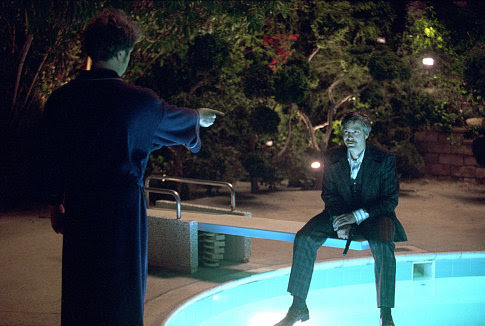
The Barris story's madness and what could be Clooney’s naivety behind the camera instead of in front of it allow the Ocean’s 11 star to deliver a film that is off the chain with visual “moments”. A Delightfully assured tracking shot has Barris touring the halls of NBC only to be the host of the same tour an instant later. Meanwhile briskly cold silhouettes situate the frosty European countries that the TV presenter must navigate to find his targets. When time allows Clooney slots, Rockwell, in front of mirrors to implicate the duplicity. That’s not when he’s having telephone calls meld into the same location or having C.I.A agents bleed artfully into swimming pools while sitting on diving boards.  A late sequence has Barris having a mental breakdown in front of an imagined slaughtered audience. A terrifying vision of a CIA hitman losing the plot? Or are we watching a deeply troubled producer seeing his brain-dead shows kill off the smarts of the audience? This is contrasted with an earlier scene in which a desperate Barris sits in a full auditorium glumly watching a movie while everyone around him is kissing. When Barris meets the free-spirited love interest Penny (An enjoyable Drew Barrymore), they’re seen necking in the theatre while everyone watches the movie intently. Seems that ol' Chuck never seems to fit in with the crowd. So why not envision them dead? It’s a moment which feels strangely apt for such a cracked mind. All this is delivered with a brightly lit retro colour palette and a wink to his usual collaborators. Blink and you’ll miss some friends of Clooney’s looking flummoxed on the dating game.

It's no surprise that it can all feel a bit much for some. Maybe a feeling of Clooney enjoying himself a copious amount. The film’s screenplay was written by Charlie Kauffman, the misanthropic creator of such gems as Synecdoche, New York (2008), and I’m Thinking of Ending Things (2020). Two incredibly cynical mind benders. Kauffman has stated his frustration with the finished film, with talk of a drug addiction subplot excised from the final film. Confessions is all a bit too sprightly for the dark trappings that inhabit most of Kaufman’s work. The screenwriter highlighted that this was more of a script on order, which had lounged in development hell for years than anything else. Jumping from director to director before finally landing on Clooney’s lap. As accomplished as Kaufman’s creations usually are, this is far from his more sardonic imaginings. And considering the grimness which inhabited I’m Thinking of Ending Things, that’s perhaps for the best.

Weirdly enough, Confessions still has enough Kaufman DNA inhabiting it to remind you of the scribe. This is a film about a self-loathing white male talent, wracked with self-doubt despite his success. This of course runs through the likes of Adaptation (2002) and Synecdoche, New York (2008). Although what’s perhaps lacking in this over the likes of films such as Being John Malkovich (1999), Eternal Sunshine of the Spotless Mind (2004), and Anomalisa (2015) is the element of communication breakdown between the film’s lead and everyone around them. If anything, Chuck Barris is a superb communicator. With the likes of Dick Clark leading the famous parade of known talking heads informing us of Chuck’s brilliance. Barris perhaps has too keen an ear on what the people want. His shows are not only still being observed in similar ways today, but also seem to be the type of “low culture trash” that can draw in huge crowds. The Gong Show feels no different from the most popular element of X-Factor. Praying on normal people who seek attention, despite maybe not having the inherent media talent for true success.

“…To mock some poor, lonely people who just crave a little attention in their lives. To destroy them. So everybody’s not brilliantly talented. They’re still people. They deserve respect and compassion. I mean, who the hell are you? What the fuck have you ever done that elevates you above the pathetic masses? Oh, I forgot, you created “The Dating Game”. Wow, right up there with the Sistine Chapel.”  - Pretty Woman

This quote is perhaps the most stinging moment of the film. And perhaps one of the most crucial. A withering blow to the strutting male ego. A beautiful, unknown woman dissecting Barris for what he is. Suddenly no matter how often we frequent Barris’ more dangerous alternative life, this woman’s burning critique feels seared onto Barris like a branded cow.  This is a man who wished he was more than what he became. Even when at the point of success, he is haunted by what could be considered imposter syndrome. George Clooney is interested in the moment where media & politics collide. But that truly comes later. In Confessions, this is the filmmaker going down a road well-travelled. That of a mad male talent and his demons. Is Barris telling the truth? The answer perhaps lies in how much you feel about appealing to the lowest common denominator and when you’re called out on it.  The film ends with perhaps one of my favourite quotes as the actual Barris is sat down, much like the docu-style talking heads from earlier. The lighting is harsh and bright. Blasting out any wrinkle or detail. The final moments are as earnest as they are depressing. Barris’ last quote is as follows:

"I came up with a new game-show idea recently. It's called The Old Game. You got three old guys with loaded guns onstage. They look back at their lives, see who they were, what they accomplished, how close they came to realizing their dreams. The winner is the one who doesn't blow his brains out. He gets a refrigerator."

I think it tells us all we need to know.


Confessions of a Dangerous Mind is on various streaming platforms. I dug out an old DVD.

Dug what you read? Buy me a Ko-fi!


Monday, 5 January 2015

Review: Escape From Tomorrow


Year: 2013 (U.K Release 2014)
Director: Randy Moore
Screenplay: Randy Moore
Starring: Roy Abramsohn, Elena Schuber, Katelynn Rodriguez, Annet Mahendru, Danielle Safady, Alison Lees-Taylor

Synopsis is here:

Despite suddenly appearing on Netflix awkwardly, like a Vine comedian whose has been deemed sexist, Escape from Tomorrow caused quite a stir within cinephiles due to its conception. Its director; Randy Moore uses a combination of iPhones for scripting and consumer grade DSLR cameras to create an entire feature film within Disneyland, Florida, without permission from the owners. Moore's film holds more footage of Mickey's merchandise, rides and scenery than a regular Hollywood feature would be able to legitimately pay for. When viewing the film in its entirety, you can see it's not just a gutsy move, but a logistical nightmare. The film was clearly planned in a way to conceal what Moore and his crew was actually doing. Moore himself was so worried that someone might catch what he was up to, he edited the film in South Korea.

While one could deem the shoot problematic, you can't say that all the work wasn't worth it. Moore is able to show the "happiest place on earth" in a negative view, while avoiding Disney's notorious lawyers. Fair play to the man. Yet despite this, I found Escape from Tomorrow's origins to be more interesting than the film itself. Moore's film; a deeply personal film that delves into a newly unemployed man; Jim White, descending into madness during his family's last day at Disney, is often hampered by the guerrilla tactics that allow the film to even be. The film's blurry, out of focus monochrome visuals were considered by the director not only to ease the pressure of editing, but to shape the bizarre imagery itself. This brings mixed results, as the film is a blend of artsy home video and rushed student production. Unlike the early fixtures of the mumblecore movement, the film never feels at ease visually. Yet in a ludicrous catch-22, the film could not be produced in any other way. At one point, a family argument ends with the camera fumbling gracelessly at the infamous castle merely to establish that once again, Disney is the backdrop.

Escape from Tomorrow also suffers from a flaky narrative which nods towards the surreal but lacks true cohesion. We witness Disney Princesses shown to be high class hookers to Asian businessmen, how does this connect with hypnotising evil queens, cat flu outbreaks and a regressive sci-fi experiment? The connective tissue is irritatingly loose. There's clearly a way of making all this ambition gel, but possibly not by having the protagonist father ogling underage teens. Making this one of the driving factors of the plot does little to drive compassion. Then again, the White family is difficult to draw any empathy from in the first place. 

I found myself comparing EFT to Clare Denis' Bastards (2013), a film which starts out as equally as oblique as this one, albeit not as surreal. Bastards also follows an unsympathetic family, and yet the film's tone, the performances and mosaic editing had me absorbed in its puzzle. Escape from Tomorrow struggles under the weight of what it is, and so never truly comes together emotionally or conceptually.

Escape from Tomorrow never really gains a sense of self, although it does well to push the "sinster Disney" angle. This only ever feels like part of the puzzle. Moore; whose childhood clearly has ties to both Disney and his own father (their relationship deteriorated as Moore grew), clearly wishes to excavate some demons with his piece. Some elements work conceptually while the underlying themes could speak volumes if Moore had more time to work on the film's flaws. At a time in which critic A.O Scott laments at mainstream America's arrested development, Escape from Tomorrow's setting and ideas set a troubling reminder of how childhood fantasy, adult mortality and capitalist ideals can converge and warp the sense of family intimacy. Watching the film after the Sony Hack also help illustrate how one can take a pot shot at corporations by using creative methods or destructive ones. One does hope that more can distil some of his ambition and implement his talents into something that won't have him looking over his shoulder constantly.


Monday, 22 September 2014

Review: Calvary

Year: 2014
Director: John Michael McDonagh.
Screenplay: John Michael McDonagh.
Starring: Brendan Gleeson, Chris O'Dowd, Kelly Reilly, Aidan Gillen, Dylan Moran, Isaach de Bankolé.

Synopsis is here

I enjoy films about faith. I feel much of this stems from my upbringing and my grandmother; a woman whose faith in the almighty seemed to never waver. When she was told about the ailment which caused her demise, as opposed to facing hours of operations and hospital treatment, she decided upon staying at home and going peacefully with her family as it was the “will of god”. I admire such a choice as much as I feared it. Possibly because I’m still young. I’m currently not sure I could make the choice so readily. Even if I was at the age she was.

For me, I find this to be an often neglected cornerstone of faith, often glossed over by the more arrogant members of the new atheist movement, who are very quick to inform us of the corruption and wars that religion plays a part in, or how scared people are to find solace in faith. We often never hear of these folk telling us about what moral good that they themselves perform. All wrapped up in the sins of the church, some seem to be far too interested in maintaining the view that the world is an insidious and ugly place. One of my favorite qualities of my grandmother is how she interpreted faith as a source for good, no matter what denomination. I love seeing that in films like Calvary, a film that beautifully illustrates the idea that the goodness in faith must stand defiant in front of those who only wish to mirror the ugliness that resides within the world.

Calvary’s focus on its weighty subjects start with what sounds like a dark absurdist joke. Opening with a beautifully composed shot of Father James (Glesson) sits solemnly in the confession booth as a voice whisper to him that they first tasted semen at age 7. The more depraved may crack a grin (sorry), but this moment is a telling one. The Irish voice, the line of abuse, the troubled grimace of the face as the ears register what is said. One of the films subtexts, the abuse carried out by the Catholic Church is richly brought to our attention within minutes. The conversation only seems to get worse. The exchange digs deep into each participant psyche till we reach the inciting moment: the person we don’t see on the other side of the confessional wishes to kill the priest. To kill this priest, a good one, will say more things about us than if a bad one was murdered.

Father James seems to know his killer and after being introduced to the town’s oddballs and eccentrics, most viewers will know too. Writer/Director John Michael McDonagh almost displays the identity as an open secret. However, Calvary is more interested in the mysteries of our morals and guidance than it is about a maybe murder. Calvary holds some the darker humor of McDonagh’s previous effort, The Guard, but is much more meditative and pensive thematically. Calvery is a film, much like the slightly more pious Of God’s and Men (2010), which helps question the place of faith in a messy modern world.  With his fate considered sealed, James continues to provide penance and advice to those around, while they do their best to condemn him and the church and frolic in their impurity. Why does Father James continue his work with such a cloud looming over him? Why does he seemingly do little to try and alter the course?

The eccentric village folk do very little to help matters. At one point a resentful publican belligerently questions James on why the church hasn’t done anything to attack the banks, and their part in the economic crash and yet amusingly such thoughts fit snugly into more questions of who why and how we observe faith. To snub one’s noses at religion and what it may bring to some is of course the easiest thing. It’s also clear that Father James feels his doubts prick at him like acupuncture needles that are slightly too large. Then again, when it comes to faith, doubt can hit anyone.

Calvary may set up the idea that its lead is Jesus-like, but the film also does well to ground him as a man who lived a life before the cloth a man who pushed past the wrong to allow faith into his life. This is not a man born into the burden and there are times that we see and know that it must be hard to keep the halo from slipping. For a man of Gleeson’s size, he manages to carry such vulnerability with great balance. The boorish behaviour from The Guard (2011) is not shown here, but the sensitivity certainly is. “There’s too much talk about sins. Not enough about virtue.” James utters at one point. This line, like many in the film's screenplay manages to get under one’s skin for the better.

The film is visually based on sparse paintings of Andrew Wyeth, and cinematographer Larry Smith’s bold compositions illuminate the darkness that lies between each scene, but Calvary is anchored by the weighty performance of Gleeson, who carries himself like every inch of his soul is troubled by the unsaid burden placed around him. Yet James plays on despite the prickliness of the village oddballs.

Whether or not our protagonist of the story embraces or fears death is one thing, but the fact that he acknowledges fate as he wanders through what may be his last week becomes suddenly profound. In the slightly distanting landscape of modern mainstream cinema, which is often invested in near immortals keeping all of us safe, James’ heroism isn't about saving the whole world, but doing his best to affect the close ones within his, despite their naysaying. The fact James decides to do this through faith brings poignancy as those around him feel that they know better but do a little better for themselves. Calvary, like my grandmother, gives insight into how the small steps of faith can bring clarity and courage. Not only to those who believe, but those who may not believe. I enjoy films about faith and Calvary is a welcome and inspiring one.

Tuesday, 22 October 2013

Review: Blue Jasmine

Year: 2013
Director: Woody Allen
Screenplay: Woody Allen
Starring: Cate Blanchett, Sally Hawkins, Bobby Cannavale, Andrew Dice Clay, Peter Sarsgaard, Michael Stuhlbarg, Louis C.K.

Synopsis is here

The annual Woody Allen feature comes to us with a performance so strong it beggars belief. I don’t care for awards season, but for those out there who have stumbled upon this tiny blog who hold interest I will say this: Cate Blanchett should have 2013’s best actress all wrapped up. If someone else wins over Blanchett then I must congratulate them, as they've toppled a performance of some magnitude.

Blanchett’s Jasmine is a hurricane of destruction and delusion it is difficult look away from. It’s always exciting to someone take a film by the scuff of the neck and dictate things like a conductor. However I found Blanchett to be so strong, that even the other solid displays felt dwarfed.  Allen brings together a multi-faceted cast that engages well with the material. But Blanchett, she just blows them away.       

Blue Jasmine at heart is a tale about someone who can be happy with a little and someone who despairs despite once having a lot. Self absorbed and pretentious; Jasmine is a difficult character to feel for. Told in flashback, we find that Jasmine is held together by the riches of her husband.  Everything is about stature and branding. We notice she changed her name due to money. She looks down her nose at her sister and fiancé with the kind of condensation you only ever find from those who are far too privileged for their own good. There’s insidiousness in the way Jasmine feels the need to tell her sister that she can do better. At no point do we feel that what is said is done for the good of anything other than Jasmine’s self satisfaction. Little bothers her, because material keeps her warm at night. We also think it keeps her oblivious to important matters at hand.

When we find Jasmine in the present and uncover the reasons of why she’s visiting her sister, we notice just how fragile her ignorance and finance have made her. Jasmine is a fractured creature that would get on well with Penelope Cruz’s Maria, whose emotional imbalance heightened the tone of Allen’s Vicky Christina Barcelona. However while that film joyfully played with Latin melodrama, here we only have spite to comfort us.

As the film plays on, Blanchett’s pained performance breaks through so much of the films other segments. Blanchett switches from distant to destructive to switched on in a blink of an eye, and cuts through much of the humour (the support is engaging yet cartoony in characterisation) that tries to diffuse the drama. As the film continues on, we notice just how troubled Jasmine has become. I struggled with the films humour unlike the snorting and snarky audience I watched it with, who had no trouble. Jasmine isn’t pleasant, but it’s hard not to find pathos as Jasmine becomes more unhinged.


That said, Allen’s poor people are doing A-ok while rich people pay for their sins comes across a little false. Despite Allen’s provocative use of form (Jasmine is often bathed in golden hues, or blocked out of focus during certain plot turns ), he never takes his idea as far as he can. We have a conceit in which the high class wives of the financial elite have just as much to hide has their criminal husbands. Allen places a cynical turn on the phase “behind every good man is a good woman” but does little to convince us of his conviction. This loose, modern day telling of A Streetcar named desire squarely lands us amidst the spectre of the economic crash, but fizzles out without wanting to take a good clean stab at the issue. It’s too bad, as Blanchett is more than willing to make the effort.        

Sunday, 9 June 2013

Review: The Hangover: Part 3

Year: 2013
Director: Todd Phillips
Screenplay: Todd Phillips, Craig Mazin
Starring: Bradley Cooper, Ed Helms, Zach Galifianakis, Heather Graham, Justin Bartha, Jeffrey Tambor, Ken Jeong

Synopsis is here

There is one question a writer must ask before he puts pen to paper for his screenplay. It's something that the audience don't even ask themselves before they sit to watch. Never the less; it must be asked. The question is simply: why should I care about these people? Such a query must be asked and it definitely must be answered, even in the most basic of terms. The audience may not think they care, but subconsciously they need to know that if they're going to spend 90+ mins with these people, there must be reasoning to back them.

Hollywood right now is in a franchise fronted, risk free circle, that it may never wish to break, as long as the pay is good. Films are becoming more like soap operas with characters having to trip and stumble over the same hurdles again and again.

The Hangover worked on a guy like me because it was a decent one shot idea; four misfits thrown together into a wild circumstance. It was rude, crude and a little bit dumb, but there was something in there that kept me watching. The second film was more of the same but not in a good way. Fool me once shame on me, fool twice, I'm an idiot. The same goes for these guys as they hit the same beats of the first film but with more spitefulness and diminishing returns.

We are now lumped with a needless third film in which the hangover is no longer a literal one, but a metaphorical one in which the Wolfpack's previous antics have caught up have finally caught with them in the shape of Leslie Chow whose rampant criminal activity has sparked a rival gangster to take action. The Hangover Part 3 forgets about being an actual comedy and in turn becomes a crime film with comedic elements and uninspired reminders of the previous entries. It failed with me on all accounts.

The reason is down to the rambling I was mumbling about at the start of this review. Why should I care about characters who have outstayed their welcome? What were a bunch of amusing guys you could relate to, are now a miserable bunch of irritants. No longer do are the protagonists balanced. Once Alan became the "break out" character of the first film, more focus has been placed on him. He's obnoxious and belligerent but the film does nothing to balance this. Like the Phillips produced Project X (2012) we have a nasty character and his faults are celebrated to the extreme. Add to this that he's also mentally unstable and we have a potent mix. 

Comedy of cruelty is difficult, but brilliant if done correctly. Films such as Martin Scorsese's The King of Comedy (1982) or Jody Hill's Observe and Report (2009) manage to blend the absurdity and pathetic qualities of their characters so well that you don't simply focus on their nastiness. Another example would be Mitchell Hurwitz's brilliant dense sitcom; Arrested Development (2003) which manages to add pathos to a group of characters you would walk across the street to avoid in real life. By the time the boorish creatures in The Hangover Part 3 reach their unearned emotional conclusion, I had my fill. 


For me; the film’s only saving grace was Ken Jeong, the only person who remembered that he was in a comedy. Jeong's nastily stereotypical Chinese character, has some of the best lines and the most energy in a film in which the listless looks on the leads faces are all too obvious. But think about that. The character that most people have a negative issue with is the only thing I found interesting within the film. Colour me backward, but I feel that says everything about The Hangover Part 3. A bloated, lazy comedy in which I had to focus on its most negative aspects in order to find a laugh.  

Sunday, 30 December 2012

Review: Sightseers

Year: 2012
Director: Ben Wheatley
Screenplay: Steve Oram, Alice Lowe, Amy Jump
Starring: Steve Oram, Alice Lowe

Synopsis is here:


In 1996; school disco halls everywhere were loud with the sounds of awkward shuffling and the heartfelt warbling of Gary Barlow and co. Before disbanding in 1996 (and reuniting in 2006), Take That released their cover of the Bee Gee's hit ballad "How deep is your love". The couple we follow within Ben Wheatley's Sightseers would have been around 16 at that point. I'm sure that you can imagine either of the two, sitting alone, mouthing the words. All the while, their friends (if any) were victims of cheeky gropes and similar tomfoolery.

Upon watching the film; I found myself asking: "Is anyone surprised that two people like this would find each other?" I certainly wasn't. Nor was I surprised. Due Tina and Chris being in such a young, developing relationship, their passion is what you call...intense.

Said intensity is key for a director like Wheatley, and perfect for a movie like Sighterseers, a film which, like Four Lions, revels in thorny issues for its comedy. It's Natural Born Killers (1996) by way of Dear Deirdre; gleefully wrapping it's lovers on the lam narrative around Fargo-style eccentricities. The film even inverts the impotency issues that Arthur Penn's Bonnie and Clyde (1967) delved into. It's not like neither character can articulate their lustful thoughts (just take a glimpse Tina's knitted, crotch-less panties), but there's a drollness in that while Clyde excelled in looting paper, Steve can barely place his thoughts down on any. Beatty's Clyde may not have been able to get it up, but you sense he may have had enough charm to write a book.

Literacy issues aside, Steve (a quietly sinister Oram) is a messy quagmire of lust, rage and loneliness, desperate to introduce Tina into his world of caravanning, local sights and premeditated murder over trivial incidents. Tina (a superbly comic Lowe), a withdrawn young woman, living in the palm of her controlling mother (a callback to Wheatley's 2009 film Down Terrace), seems to become more besotted by Steve due to his method madness. Is she intoxicated by the violence she's encountered? Or did the darkness just need to be awakened? At one point, Tina is insulted in a way that seems exaggerated at one point, but feels on point later on. We're never really sure about the two, other than their passion. Clues are laid, like Kill List (2011), Wheatley suggests things, but he never runs for an easy answer.

The holiday is often the test of the relationship and it is no different here. The relationship slowly degrades as their unstable personalities clash and circumstances close in. But Wheatley has coated the situation with such rich British idiosyncrasy that he manages to unlock mirth within the macabre. He toys with British politeness and tolerance in a way that reminds me of Serial Mom (1996), John Water's camp subversion of the suburban American Household. Sightseers's is angrier than that, and has more to comment on. The films cinematography is quick to highlight just how entrancing The Lake District can be, and yet it's is completely lost on these murderous characters. It is lost on us as well, as we're too busy indulging in their darkness. But there's the joke. We watch the observational comedy, smirk at the all so true moments with passersby and secretly delight at the couple’s murder spree and we forget how their intentions seemed good. 

What I love about Sightseers is just how passionate Chris and Tina are about themselves and what they do, even if it's completely immoral. The observations found in the script are not only infinitely quotable but often endearing, although; you would probably be a little more pensive with a Daily Mail reader. The film’s title, holds a certain irony to it, as the films climax suggests that the Chris and Tina themselves are "nice enough" to visit but not the type of people to stay with. They're the type of couple that is considered "just a bit off". The final decision made by the couple is sweet, humorous and yet haunting. It asks the question that Gary, Robbie and the rest of them were banging on about, back when we only had two lonely singleton teens. How deep is your love?

Tuesday, 23 October 2012

Review: John Dies at the End

Year: 2012 (Viewed at the London Film Festival)
Director: Don Coscarelli
Screenplay: Don Coscarelli
Starring: Chase Williamson, Rob Mayes, Paul Giamatti

Synopsis is here:

I told the work colleague who put me on to the novel John Dies at the End, that the film would be way too bizarre for a large scale release of any kind. Not normally so optimistic (a Birmingham City football fan), my friend was as sure as he'd ever been that having Paul Giamatti on the cast list would do everything a film this kooky would need to get released.

It just so happens that watching this at the LFF was a stroke of luck, a short Q and A with the films director clarifies the films U.K distribution issues (unknown). Safe to say that those who got the chance to watch the film at the Hackney Picturehouse (along with the others who may have since it in other one off screenings) are lucky sons of bitches. Unless of course they didn't enjoy the (as quoted by the director himself) batshit antics of David Wong and John Cheese.

Those names should be familiar to those who enjoy cracked. The novel is a mass melding of pop culture and the supernatural, a twisted buddy adventure written in a snappy, quick witted prose that captures a similar anarchic feel that Kevin Smith slackers usually enjoy.

While light on solid plotting and true scares, John Dies at the end has the free-wheeling humour and nuttiness that makes the book such a fun distraction. Much of the films spirit is due to don casting the perfect duo to bring the spirit to life. Chase Williamson and Rob Mayes may be unknowns and their rough edges do show, but the assured chemistry that appears between them, drive the film. Paul Giamatti looks a little out of sorts with the whole thing, but then again so did some of the audience (we had two walkouts)

The film does as much as it can to keep hold of Wongs prose, but some of the more adventurous elements are missing due to budget restraints. The loss of them is unfortunate, as is some of the darker more twisted elements of the characters (David is a way more nihilistic character in the book) however the film manages to stay consistently funny throughout, while holding a claustrophobic visual style that reminiscent of  The Evil Dead. No bad thing, the film is one of the closet entries to that series, although I'm not sure the hardcore will agree or connect as strongly. It may be dependant on how much they dig juvenile web humour. Guess which camp I'm in.

Those who know Don Coscarelli from Phantasm may feel differently about the film in some of the content. However, this is pure Coscarelli territory in terms of theme. A buddy horror road movie that goes off kilter at a drop of a hat? You wouldn't be surprised if The tall man himself appeared (Angus Scrimm makes an appearance).

JDATE is a compromised vision, but an enjoyable one all the same. A web or TV series could have encompassed most of the craziness, but its cinematic journey never bores, it's far too drugged up on soy sauce to give a damn.


Tuesday, 17 July 2012

Review: God Bless America

Year: 2011 (U.K Release 2012)
Director: Bobcat Goldthwait
Screenplay: Bobcat Goldthwait
Starring: Joel Murray, Tara Lynne Barr and Mackenzie Brooke Smith.

Synopsis is here

Former stand up comedian; Bobcat Goldthwait's satire is a simple one. The targets are as plain as the nose on it's face. This is not a problem for me. I enjoyed many of the barbs the film hurls, as most of the time the film ranges from moderately to highly funny. Goldthwait's jabs at loosely based parodies of neo-con political commentators, American Idol and trashy reality shows are warmly welcomed. In fact the main conceit, in which a man goes postal due to the ugly cynicism being fed to him (and everyone else) by media outlets and the like, is the sort of wish-fulfilment fantasy that must be gaining more patrons by the day. Goldthwait tries to up the stakes by giving us a central relationship, that is given the same type of troublesome affection, usually reserved of the likes of Todd Solondz. Once again no real issue here.


However, much like Goldthwait's previous feature World's Greatest Dad (2009), God Bless America is quite the one note affair, and unlike it's predecessor, is a little too scatter shot to remain truly remarkable. The anger seems to be there. Goldthwait's film gives us a very strong motif that follows us throughout the film.Diana Ross' Theme from Mahogany is heard throughout, being poorly sung by an X-factor wannabe laying out the intent as clear as day. Is this quagmire of lowest common denominator pap, where we wish to be lead? Living as products of fear with only the antics of fame hungry nitwits to make us feel better about ourselves?


Goldthwait sets the path out quickly and assuredly, the parodies and idleness of the masses are right on the money at the start. The ironic moment in which our protagonist; Frank (a neatly sad sacked Joel Murray), is fired for an extremely decent gesture, amidst a crowd of wage salves guffawing over the last nights sneering T.V show hits home with a wit that's sand paper dry. The absurdity feels far too plausible.


For a while it doesn't let up. A PG rated Sweet sixteen style show, in which, the birthday girl is screeching swear words at her parents for getting the wrong car, is layered on by Frank's own daughter mimicking the same bratty attitude over the phone. When Goldthwait gets it right, he gets it right.


That is until the movie hits the road, and the cold blooded killing starts. Where the energy should rise, it falls. Slowing  for characters spout dialogue that feels more like a stand up comedian's rantings than something that comes out naturally. It's not that I don't agree some some of the points, it's more that it sits awkwardly within the film. Goldthwait moves more towards the central relationship between the middle aged Frank and the teenage Roxy. The sweetness between the wannabe Bonnie and Clyde doubles, but the focus lessens the easy targets become quite thinly spread and the film slowly loses it's bite. 


Any real complexity stems from the character of Roxy (an energetic Tara Lynne Barr) whose reasons for joining Frank give the film a shot in the arm late on, when we find out that Goldthwait has nowhere else to direct the rage. Television is one of the villains. Not just in the film but outside too as the antics of Charlie Brooker's Dead Set (2008) and Black Mirror (2012), are far more focused affairs that are just as black but far more rewarding. Goldthwait should however get full marks for his efforts. Barr donning an imagery that evokes Brenda Ann Spencer, and the films all out final moments provide more interesting hints of Goldthwaits outlook and anger. Such venom however, still needs discipline to be truly affective. 


Monday, 9 April 2012

Review: Headhunters

Year: 2011 (U.K release 2012)
Director: Morten Tyldum
Screenplay: Lars Gudmestad, Ulf Ryberg
Starring: Aksel Hennie, Nikolaj Coster-Waldau, Synnøve Macody Lund, Julie R. Ølgaard

Synopsis is here

Headhunters appears to be gleefully taking advantage of a small-scale Scandinavian invasion; that looks like it kicked off with the likes of Let the Right One In (2008) and The Killing, but actually goes back further with the likes of Christopher Nolan's Insomnia (2002) and David S Goyer's The Invisible (2006) being remakes lifted from Scandinavian counterparts (1997 and 2002) respectively). As I sat watching the film I already had myself wondering who would be cast in a tamer Hollywood retelling* (Steve Buscemi, Diane Kruger and Arron Eckheart).  But before the cash claws of California begin to dig in, the original is sitting in cinemas trying to benefit from counter programming, sitting in-between the likes of The Hunger Games and Mirror Mirror.

Those's looking for a more po-faced thriller; the likes of The Girl with the Dragon Tattoo, may be slightly disappointed. Headhunters is in no way as serious and dark as some the aforementioned titles. Far from it, in fact, as it titters from mild mannered Ocean's affair (the slightly intrusive score evoking David Holmes) to graphic but mostly ludicrous violence. The perfect litmus test; is how a viewer feels about a protagonist finding himself nestling in a faeces filled toilet, using a loo roll tube as a breathing apparatus (and piece of camouflage).

The film descends from light hearted caper to droll cat and mouse chase as the Macguffin is quickly forgotten and the unorthodox looking Aksel Hennie panics franticly from absurd set piece to the next. The film delights in abusing it's lead to near Evil Dead levels. Bodies pile up, dogs are skewered, the aforementioned "poo dip" and the reason behind everything is all very silly. Despite being a leading Headhunter for a large company, the oddly named Roger Brown, wishes earn more money stealing art to keep up an ridiculous lifestyle and his impossibly good looking wife happy.

The set up doesn't sound too out of the ordinary considering, however, what makes the film interesting is not only the mere fact that Brown has to literally shave his head in order to physically keep it, but that the film uses it's oddball mixture of big business recruitment and art nabbing hijinks as a metaphor for grandiose dick swinging and bruised masculinity. Such aspects do go against the Hollywood grain. The film display its hero as a flawed individual who is physically wanting also. As our anti-hero is slung from pillar to post we soon realised he is being punished for his status claiming and lack of humility. The idea of such a character getting battered about due to his compensation for his small man syndrome, you can't help but giggle slightly. One of the films strongest and most telling scenes involves Roger meeting the antagonist Clus (Nikolaj Coster-Waldau) at an art gallery opening (how droll). Clus' model good looks and easy charm are used as in sharp contrast to Roger.

Strangely this is where the film left me. While I found myself absorbed in the movie as it revelled in it's madness, when the film has to explain itself in the third act, it doesn't stand up as well. Reasoning and  motivations flounder and become hazy while the pay off, though fine thematically, is played out as typically as the American films it managed to eschew for the most part. I'm sure most people won't mind and go along for the ride. However for me, the film nearly stopped dead in it's tracks for me.

Despite it's weaker third act, Headhunters utilizes it morbid sense of humour to it's fullest and manages to play out it's thrills far more effectively than the likes of such nonsense like The Tourist. Headhunter is slick and snappy entertainment, which is well cast and tightly put together. One could say for the most part the film got its head screwed on...sorry.

*Note: Upon writing this post, I found out that the remake rights have been brought by Hollywood already (before this film even came out).

Thursday, 9 February 2012

Review: Young Adult

Year: 2011 (U.K Release 2012)
Director: Jason Reitman
Screenplay: Diablo Cody
Starring: Charlize Theron, Patton Oswalt, Patrick Wilson

Synopsis is here

I found myself quite shocked at the quite lacklustre amount of London cinemas screening Young Adult. Despite  a decent amount of buzz, awards and great reviews, the film only seemed to open in one or two places. In fact, bizarrely, it looked easier to watch the film outside of London than inside, with both of the shire areas (Bucks and Cambs) that I frequent, not only having cinemas showing the movie, but a decent amount of screenings in each.

I actually found myself, more shocked at the cinema situation, than Young Adult itself. The film is somewhat unconventional, with its lead performances, and has a roguish charm that comes through many of the scenes. Yet, by the end of it, much like Martha Marcy May Marline, I was only moderately satisfied. I have no issue with settling in with selfish, unlikable characters, but with Young Adult, I got the feeling that it said everything it needed to say quite quickly, and I had no other reason to stay.

The film follows the same route as previous Reitman features. We are given a character who is independent or at least believes they are, who when challenged, look for solace in al the wrong places. Reitman's film finds the same beats he's hit before and Diabio Cody returns (their previous collaboration being Juno) to play upon the same arrested development notes that did so well before. Only this time the vessel is a 37 year old mega bitch as opposed to a 17 year old snaky teen.

The character of Mavis is more than a little difficult to get to grips with, but not without a certain appeal. A deluded creature, trapped in a bizarre womb of bad reality T.V shows, diet coke breakfasts and doomed nostalgia. Much like so much of our culture recently, she is completely fixated on her perception of the past and will not let go of her childish, self serving attitudes of her childhood. Credit is due to Theron as she attacks the material ferociously, and accentuates the bitterness that such a person would hold on to. Her partner in crime, is Patton Oswalt whose Matt Freehauf is equally as damaged and regressed and the films sharpness is highlighted best in the scenes between the two.

There is a bitter-sweet nature to the whole of proceedings that litters many of the films scenes. A lunchtime scene scene at Mavis' parents has her seemingly serious cry for help laughed off, while Matt's telling line of "guys like me are born loving women like you" is one that should ring true to many a nerdy male ear. But the film's final third feels a little detached, as if it was hinting towards something before turning it's back. The films  final coda gives the clear notion that while Mavis' arc must end on a pitch that leaves some warm and fuzzy feelings left in the belly. Although if we ignore the voice over and look at Mavis' banged up mini for metaphor then life may take circular turn.

All in all, the film is quite simply not greater than the sum of it's parts. Reitman is not known for his visuals and does an OK job, but nothing helps the movie stand out. Theron and Oswalt show true quality in their displays, while Patrick Wilson puts in another shift as Mr J Bloggs. Cody's screenplay has bite but doesn't have the killer payoff to leave you reeling. This said the film will make you laugh and shift uncomfortably in your seat. It's just that, if your like me you may only have to see it once. 


Thursday, 22 December 2011

Review: Bad Teacher

Year: 2011
Director: Jake Kasdan
Screenplay: Gene Stupnitsky, Lee Eisenberg
Starring: Cameron Diaz, Justin Timberlake, Jason Segal, Lucy Punch

Synopsis is here

I'm sure that there's a few people, who drop by this site, and read my negative reviews on comedies and probably think I have a humoroscopy. My last review on the quite lacklustre Horrible Bosses will probably have way more people disagreeing than agreeing with me but in the blogosphere it's expected. I won't be surprised that the same people who rated Horrible Bosses a high ranking 7.1 (as I write this) on the IMDB, took offence at the Cameron Diaz vehicle Bad Teacher and gave it the 5.7 it has to settle with.

After watching the two pretty much back to back, I've gotta say that at least Bad Teacher doesn't pull it's punches. The subject matter may not be as dark but the subversiveness is there. I laughed and tittered as Diaz revelled in a role she loved playing. I will not try and defend the fact the film is not one note, but there is enough in the performances (particularly Lucy Punch and Justin Timberlake) to keep me watching. The film has just enough brazen energy to keep things ticking.

Most of the energy comes from Diaz who comes across as an evil Dewey Finn. I liked her timing; as I have in the past, and there are small moments throughout the film involving her character I just enjoyed throughout. At one point we see that her also unsavoury flatmate would rather go out elsewhere than sit in and get "shitfaced" with her. The films car wash set piece is something one could see a mile off but still brings a silly giggle. It all seems to be down with how much you dig Diaz in the role. I've seen actresses that could perhaps do more, I know a ton that could do a lot less. However, Diaz did enough to make me want to see what will happen next in the next scene. I liked her interaction with the kids, as well as her drab banter with Jason Segal.

I guess Bad Teacher got me due to low expectations. Maybe I should watch films so late at night. Maybe I should have watched it separately from Horrible Bosses  The arcs are predictable but they function well enough for say, people looking for a throwaway 90 minutes pizza movie. It's mean, but I saw a glint of the characters redemption early enough in the film to plough on ahead. It's a feminist nightmare but in all honesty, unlike some other movies, its clearly in jest and winking at the camera. I can't lie, I didn't think it was as bad as many others said. Maybe I did have a humoroscopy.


Wednesday, 21 December 2011

Review: Horrible Bosses

Year: 2011
Director: Seth Gordon
Screenplay: Michael Markowitz, John Francis Daley, Jonathan M. Goldstein
Starring: Jason Bateman, Charlie Day, Jason Sudeikis, Colin Farrell, Jennifer Aniston, Kevin Spacey

Synopsis is here

As someone who is usually easily amused at pretty much everything, it's a shame that I'm so dismayed at the mainstream American comedy. Sitting through Horrible Bosses only confirmed my fears. Negative grumbling's have stated that the film is racist and homophobic. I didn't think so; and as a dark comedy, I expect a film like this to go down paths that are a little risky. The troubling thing about Horrible Bosses is it's not outrageous enough, from it's pretty bland straight characters to it's lacklustre, quickly hashed out ending, the film just doesn't push the bar high enough. I'm not the biggest Hangover 2 fan, but despite the spitefulness that infiltrates that movie, it gets the point.

Take in case the man eating, boss character of Jennifer Aniston. The film does well to show off how well Aniston looks after herself. In fact at points I found her more attractive here then when she was younger in friends. But her sexiness distracts from her point in the movie. In the same way you're not fooled when Rachel Leigh Cook puts on her hipster glasses and claims nerd, you find it near hard to believe that Day's character is completely turned off by Aniston's advances. It would be more entertaining if we had some one you could consider less attractive. I may be wrong in saying that but I do feel more comedy could be pulled from Charlie Days revulsion if the antagonist wasn't a smoking hot babe. Think Matt Lucas' Bubbles in Little Britain.

In fact I found myself relating Horrible Bosses to some of the brilliant comedies that grace our screens now. Shows that are quicker with the jokes, push the bars of taste and decency further and are generally more amusing than their cinematic counterparts. A barrage of shows including Charlie Day's own It's always sunny in Philadelphia, hit their comedic marks harder than this 9 to 5 update. I pick Day's show not only because of the connection of line crossing comedy, but because Day's Pilot for It's always sunny cost $200 and was far more amusing with it's envelope pushing. 

This isn't to say the film has it's moments. Despite undermining the comedy somewhat, Aniston is clearly game for a laugh, as is Farrell who both make the best out of their somewhat marginalised plots. It's obvious however that it's Spacey who has the most fun however, as he eats up his ignorant, arrogant asshole character with an extra large spoon. The three antagonist are infinitely more entertaining than the straight men who are difficult to even picture as friends let alone anything else. It's not that Bateman, Sudeikis or Day are particularly bad, it's just that they are bland.  Take away some admittedly amusing, awkward scenes involving a certain Oscar winning actor and you realise that there's not that much that the trio take to the party.

Horrible Bosses is underbaked and forgettable and unfortunately comes at a time in which Television is bringing stronger, more outlandish, dark humour which are better with the references and does nasty right. A night in with a good series weighs in far better than this weak entry.    

Thursday, 20 October 2011

Review: Carnage

Year: 2011
Director: Roman Polanski
Screenplay: Roman Polanski, Yasmina Reza
Starring: Christoph Waltz, Kate Winslet, John C Reily, Jodie Foster

Synopsis is here:

The film is simple. Two couples meet to civilly discuss a violent incident involving their children. Both couples dislike each other as well as their own relationships but seem compelled by their hate to remain in the room they are in. There is nothing stopping these people to leave the house (one couple almost make it twice) and yet they remain to take chunks out of each other. Their conversation devolves into childish squabble at a swift pace, covering all sorts of uncomfortable areas and philosophies. Awkward glances transform into emotional sideswipes, forced politeness descend into racial slurs. Much like Bunel's "The Exterminating Angels" Polanski gives us a brisk 80 minutes to remind us that our so called civility that we love to utilise to lord above other people (or animals) is fragile veneer nearly always willing to crack when the right pressure is applied. The film is a claustrophobic black farce with four characters who make the bastards in Closer look like Care Bears. Polanski hasn't had this fun in ages.

This is the Polanski of old, back in the apartments (see Repulsion or The Tenant) while liberally sprinkling in that enclosing feeling that haunted the images of Knife in the Water. As Polanski turns the screws you can literally see the walls crumble around these characters, so relentlessly absorbed in their own little worlds that they come across as just as childish as the kids they came to talk about. The mud is slung thick and fast and the dialogue rolls off the fork tongues with devilish glee. Polanski remains uncomplicated visually as the actors do the heavy lifting.

Craftily casted, all four performances are finely tuned, with all managing to gain laugh out loud moments, be it the bash faux homeliness of John C Reily or the droll one liners of a carnivorous Christoph Waltz. Winslet as the cold, status fuelled wife of Waltz gets the best moment of physical comedy (I didn't expect such a moment from a Polanski film) while Jodie Foster lets loose as a passive aggressive bleeding heart liberal whose whiney protests for peace through culture brought some of the most amusement from myself.

My opinion of the film is simple. One of the two films I've seen this year at the London Film Festival (work commitments have slimmed my viewing) is a tightly wound, hystercal black comedy, from a director who even nearer 80 has not lost his sharpness when it comes to the middle class climbing up the walls of their closed in apartments. I'm not sure I've laughed harder at times this year.


Sunday, 4 September 2011

Review: Super

Year: 2011 (U.K release 2011)
Director: James Gunn
Screenplay: James Gunn
Starring: Rainn Wilson, Ellen Page, Liv Tyler, Kevin Bacon

Synopsis is here

So James Gunn's Super rears it's head upon whining that it's just the same as Kick-Ass by people who didn't read the memo on Defendor and Special which both slipped under the radar. Hell even at a stretch you could bemoan that Mystery Men is almost kinda like Kick-Ass but only at a stretch. That's aside, it's no surprise to see that with similar material Matthew Vaughan brings a slick piece of gloss to the big screen, while Gunn's Super is a little darker, murkier and reminiscent of his twisted Troma roots. Super appears to us with a much more visceral look to the beatings on screen and a more troubled insight to the psyche of some of the tortured minds of these wannabe superheroes. Needless to say, Kick-ass doesn't have a squid like creature opening up a characters skull in order for the finger of god to poke the brain inside.

If that last sentence piqued your interest then you will be more than fine with Super, I know I was. I reacted to the film in the same way I reacted to Observe and Report in that you shouldn't laugh at what's gong down but the timing and absurdness of it all makes it hard not to. It revels in it's irrelevance but it also works as it has a  Rainn Wilson performance that towers over his great comedic work in The American Office. There's a softness in his quieter moments that helps elevate the performance as Wilson balance his troubled character with equal amounts of pity and pathos.  The humour is there too as his zealous yelling of "SHUT UP CRIME" were always able to make me crack a smile.

Wilson is joined by a game cast with Liv Tyler and Micheal Rooker being underused but solid enough while Kevin Bacon takes a sleazy bite of scenery once more, as he did in recent comic-book feature X-men: First Class. Ellen Page lets loose in a bizarre little role as a geeky side-kick to Wilson's Frank. However despite the film clearly being an offbeat character piece, the moments with her character seemed underwritten. I get the feeling that Gunn could have done even more with such a character, unfortunately Page's Libby is left a little to the wayside, as it a plot strand with Gregg Henry's Detective role who quickly loses important once his main scene is done.

This doesn't distract from the main fact that Super; with it's over the top violence and dark comedy, is still an entertaining distraction. While Kick-Ass lightened some elements of the original material to make it a bit more palatable to those who didn't read the comic, Super keeps things as black as it can giving the film a weird super hero, king of comedy vibe. A guy like me who knows of Gunn's z-list beginnings, found it easy to get on board with the offering we get here. For others I give you the litmus test: Ellen Page talking about her "gushy" genitals while donned in a super hero costume. Not liking that? Best avoid the movie.