Monday, 29 January 2024

Article: The Desire and the Danger - A First Watch of Looking for Mr Goodbar

When I decided to write this, the film people of the internet had rolled into day three of complaining about Sight and Sound’s 100 Greatest Movie List. Instead of participating, I decided to get blown away by Diane Keaton in Looking for Mr Goodbar. A film that’s still M.I.A in terms of physical release. Not due to the subject matter, which is tough, but due to music distribution rights. The soundtrack features disco hits from the likes of Donna Summer and Thelma Houston. The upbeat tracks date the film historically, while the lyrics also foreshadow its troubling ending. Songs like Don’t Leave Me This Way flip from being well-known floor fillers into something deeply chilling. Looking for Mr Goodbar is not an easy watch. Not in the slightest. Yet the themes raised still hold a strong relevance, while the provocative nature of the film makes it difficult to forget.

Based on a bestselling book of the same name, Goodbar is a fictional account of a real-life tragedy of Roseann Quinn, A well-liked teacher who had led a double life in her spare time. Richard Brook's matter-of-fact feature is unlike modern true-crime entries. With so many current examples enjoying placing fetishist attention placed on the murderers of senseless violence, however, one could wonder if the film's availability on streaming has been able to grab the attention of true crime junkies who know of the original case but are new to the film.

In Looking for Mr Goodbar, Diane Keaton plays Thresa, a trainee teacher whose home life is suffocating by her domineering polish-catholic parents. She studies to be a teacher while her hot mess of a sister has escaped the family home and has delved into the dual pleasures of drugs and polygamy. Theresa, at first, finds herself sexually involved with her college professor. However, the relationship is cut short before her graduation. Thresa soon obtains a job as a teacher for deaf children and proves herself to be a thoughtful and nurturing guide for her students. Her work life is a marked difference from her spare time, however, as she finds herself frequenting dive bars, engaging in one-night stands and experimenting with drugs. She soon finds herself at the hands of manipulating and self-centred men. Soon, her nightlife slowly seeps into her day job. A feeling of risk begins to stem from her precarious behaviour. Tragedy strikes when Teresa while reconsidering her personal life, has a chance encounter that changes her fate for the worse.

Looking for Mr Goodbar has no surprising plot. Theresa's story may have viewers entering the film with an understanding of the tragic crime and controversial source novel. Despite this knowledge, Looking for Mr Goodbar remains a startling picture. Even though the film is over 40 years old, the film still holds a potent relevancy as the harrowing narrative will feel relatable to many women. Although the story sets itself against the backdrop of the women's revolution of the 70s, there's a feeling the modern world has moved as much as expected. While parts of the urban scene may have faded, the misogyny found within Goodbar feels no different from today. The opening photo montage, littered with glassy-eyed men ogling young women in bars, only needs an outfit change and a gloss of paint to feel pertinent to where we are now. Something about the aged, unchanging grimness and the sense of foreboding helps Looking for Mr Goodbar remain shocking.

Goodbar’s lack of substantial physical release gives the film an added mystique. Its subject matter and lack of typical availability only compound its notoriety. Critics who have sought the movie out remain just as divisive as the likes of Vincent Canby were back in the 70s. Reviews have been quick to claim the film muddles its execution. Claire Davidson is cold towards the film. In a piece focusing on the film's soundtrack for Little White Lies, she dismisses Goodbar as redundant. Despite praising the film, Jim Owen of We Are Cult questions the struggle for Goodbar to define itself. The film's release in 1977 has the powerful lead performance by Diane Keaton overshadowed by her more affectionate display in Annie Hall. It is a curious displacement, when in contrast to the sexual allegations that dogged Hall's director Woody Allen in his later years. A strange, tangential connection of abuse lies between the two films. Along with the limited availability of the film and the critical discourse, this mixture of elements almost keeps the tenacious display of Keaton overlooked.

One thing that does not get overlooked in Looking for Mr Goodbar is the stacked before-they-were-famous cast. The film is bursting with burgeoning talent from all corners. As previously mentioned, Diane Keaton is completely arresting as Theresa. She flitters easily between sweet and sensual in a display that is intelligent, sexual, and yet without judgment throughout the narrative. Meanwhile, the supporting cast is a heady brew of then up-and-coming performers. Richard Gere appears as the finger-drumming narcissist Tony. While his appearances are brief, he hums with dangerous sexual energy when on screen. Gere delivers a similar vibrancy in American Gigolo (1980) and Breathless (1983). And it's upsetting that a generation of filmgoers may only know him as the corporate silver fox who chased Julia Roberts around in Pretty Woman (1990), if at all. William Atherton, known more for his smug, cinema bastard roles in Ghostbusters (1984) and Die Hard (1988), finds realms of darkness as James, a Welfare Caseworker. A hapless Irish American man who makes nice with Theresa's Polish Catholic parents but soon becomes unhinged as his traditional desires infringe on her sexual freedom. LeVar Burton shows up as the tough older brother of one of the pupils Theresa teaches. His stoic, no-nonsense demeanour is light years from his role as Geordi in Star Trek. Tom Berenger appears late on as the homophobic final partner of Theresa. He is equally as unbalanced as those who came before him while still presenting a different sexual danger to Richard Gere’s Tony. 

An element of the film’s potency is that despite its cast of soon-to-be well-knowns when it stays focused on Theresa rather than the many men, the film shines. Many modern true crime stories have keenly leaned towards the suspects and killers. With fans posting online their unwholesome desires for these unstable criminals. The likes of Dahmer - Monster: The Jeffery Dahmer Story have had its admirers frame Evan Peter’s portrayal of the serial killer as a pin-up. A persuasive takeaway from Goodbar is that it maintains the dubious men within the narrative as pathetic while trying to maintain an amount of sympathy for Theresa. She may enjoy an element of manufactured risk in her exploits, but her liberation and sexual freedom shouldn't cost her life.

It is easy to find parts of Goodbar reductive. At times, the film stumbles on the central theme that such a woman with her sexual freedom should not have her wings clipped. Richard Brook's stagey direction of the material sometimes struggles to do enough to complicate the matter for the better. A viewing of the film could have it read as a moralist tract, with the film arriving just before the even more conservative sex = death slashers of the 80s. A meandering side plot involving Theresa's sister Katherine begins to drift halfway through the movie. At first, she is more sexually adventurous, yet soon Katherine looks towards Theresa as an emotional anchor and is unaware of her sister's antics. By the time we enter the final third, Katherine’s exploits have led to abortions and quickie divorces. She’s suddenly moving towards societal norms, an obvious contrast to Theresa, who only has second thoughts about her promiscuity when tragically too late.

However, something about Looking for Mr Goodbar remains compelling. There is something so illuminating about Keaton’s performance that ensures the film, while overlong, isn’t lazy in what it’s trying to say.

One can throw criticism at the frayed edges of the film, yet this only pinpoints the great tragedy that hangs in the narrative. Looking for Mr Goodbar manages to highlight a multitude of struggles from intergenerational, racial and gender standpoints. The film sets up various conflicts in which characters within them will never gain the chance to move on or gain strength due to a fateful act which ends things. The film doesn’t pin down everything easily. Begging the question: If Goodbar had tightened its loose ends, could it be as compelling? Possibly not.

True Crime fiction often asks how we can load ourselves with the knowledge to calm our anxieties while protecting ourselves so that the same fate of victims is not shared. Looking for Mr Goodbar is startling because slight stumbles aside, there is no easy, comforting answer to Theresa's journey.  She battles her stifling family unit against a backdrop of women's liberation, defining her independence by her standards. There is a sense that Theresa would struggle to find this liberty through traditional societal norms. Theresa does not look for a man who fits the requirements of her father, but her sexual exploration, while enjoyable at times, does not fulfil her either. If she were to follow her sister down the well-trodden path, this also betray her newfound freedom. A streak of self-destruction lies in Theresa's behaviour, but her decisions are not what set about her demise. It is the tragic swinging pendulum of fate. Theresa's fierce independence makes her a character to root for. It also makes her unknowable. And the chilling final moments, utilising a strobe effect, are disorientating. Leaving us in the knowledge that despite being a rock for her sister, championing the young, disadvantaged inner-city children she teaches, or her fight for her sexual freedom, we will never know what she was striving for and that her ending is even more wrongfully unjust.

Looking for Mr Goodbar’s poignancy still hits hard because society doesn’t feel like it’s moved on from its talking points, despite Looking for Mr Goodbar approaching 45 years old. The disco-glazed city may not appear as dangerous as they do in this film. The dive bars that populate Goodbar would be hard to find now. Yet the fragile men who inhabit the dark corners still move among us. The type of man who can only exhibit control over independent, young women in aggressive, manipulative, or cowardly ways. Be it a gutless teacher who carries on an affair to feed his desires, a condescending potential suitor with a dated, traditional vision of relationships, or even a homophobic murderer who takes misinterpretation as a mocking dig at his own sexually. You can find these characters easily in movies today. While certain films have attempted to capture the anger and sadness within Looking for Mr Goodbar, they don’t hold a similar impact. The non-judgemental viewpoint sometimes exhibited by the lead character almost feels alien in the realm of girlboss representation that exists now. Whether Looking for Mr Goodbar will ever gain a solid physical re-issue in the UK or America, now that streaming dominates, remains to be seen. But while it finds itself on streaming channels with no sign of disappearing currently, that alone sends the message that it deserves to be discovered by a new audience and evaluated.


Looking for Mr Goodbar is currently on Paramount Plus and Amazon Prime at the time of writing.

Dug what you read? Buy me a Ko-fi!


Wednesday, 3 January 2024

Article: Ugly Enlightenment - A Quick Look Back at Happiness

January is often the month of reinvention. A month for folk to assess their unpleasant habits. With many looking towards ways of revitalising themselves for the future ahead of them. Be it career, relationships or health, January is the time for people to search introspectively about their past and present choices before looking forward to a new enlightened path of self-improvement. 

Todd Solondz is the kind of guy who scoffs at self-improvement.   

The shocking thing about Solondz’s 1998 feature Happiness is how unsettling it still is to this day. Watching the film in the era of social media only seems to highlight how much Solondz gets away with. Please note I am not mentioning too much of what happens in the film. You must see it to believe it. The film’s ironic and cynical jabs at suburbia could draw a concentrated amount of outrage. To those whom some would consider “over-sensitive.” In his four-star review of the film, Roger Ebert notes that it is “not a film for most people.” He hits the nail squarely on the head. 

Solondz’s dark satire is a medley of interlocking stories involving three sisters and the immediate connections surrounding them. The film’s painful cold open is a superb litmus test for first-time viewers. The overly sensitive Joy (Jane Adams) decides to break things off with Andy (Jon Lovitz) while on a date with him to avoid complicating things. The exchange that occurs is what the younger generations would now call cringe and suggests why ghosting is now so popular among the single. If a viewer can stand to watch this conversation without wincing, then the viewer may be in good stead for the next two hours.   

Happiness is uncompromising indie cinema that is tremendously comfortable when the viewer is uneasy. Revelling in hostility like a pig in shit Happiness is a grimly comic look at suburbia that landed a year before American Beauty (1999) but holds a cuttingness that lingers past the latter film’s pomposity. Solondz mines empathy out of the repulsive, finding an affinity for those who embrace the appalling. The women are shallow, while the men are pathetic. And this is before you realise that Happiness runs the gauntlet of the dark and upsetting. From obscene phone calls to full-blown paedophilia, the film challenges the viewer with the ability to dig out twigs of compassion from the unspeakable.   

What makes Solondz’s movie so compelling is how it states that even the perverse may be seeking contentment. He finds the darkest humour in the absurdities and constrictions which inhabit his misanthropic characters. Rewatching Happiness was invigorating. Particularly in our current climate of self-described wellness gurus and influencers shilling false promises and dubious misinformation via their social media feeds and channels. So much time they spend dropping life lessons as if they have found the key to enlightenment. One wonders what a few of the most obnoxious types would make of a film like this. Genuine hostility? Maybe. And that is what makes Happiness funny.   


Thursday, 5 October 2023

Review: The Exorcist: Believer

Year: 2023

Director: David Gordon Green

Screenplay:  David Gordon Green, Peter Sattler

Starring: Leslie Odom Jr., Ann Dowd, Jennifer Nettles, Norbert Leo Butz, Lidya Jewett, and Olivia Marcum, Ellen Burstyn

Synopsis is here:


Halfway through The Exorcist: Believer, Chris McNeil (Burstyn), the mother whose 12-year-old girl Regan fell victim to demonic possession, claims that she was never allowed into the room during her daughter's possession due to the “damn patriarchy”. In the screening that I was in, the line gained an audible “right on” cheer. In wrestling, such a moment could be considered a “cheap pop”.  It is a tawdry way to incite a reaction from a crowd. The vulgarity becomes evident later in the film when a grim incident befouls Chris, a mother who had suffered so much in the original film is dismissively wasted in this new legacy sequel 50 years on. The Exorcist: Believer doesn’t give a toss about feminism. It barely cares about the women in its narrative. But it knows that simply referring is enough.

There isn't much more to say about William Friedkin’s 1973 seminal adaptation of William Peter Blatty’s novel The Exorcist that hasn’t already been said. Its reputation proceeds it. A film that now constantly tops the best horror ever lists. Its infamy entails a troubled production, rating controversies and initial mixed reactions from critics. 50 years on, the aura surrounding the film has never quelled. It remains a fascinating film which despite its intentions, has allowed the contents of the production to be argued and debated for years. Its success also allowed the studios to greenlight a multitude of sequels and prequels to mixed reactions.

The Exorcist: Believer has been delivered to audiences by David Gordon Green. A director whose filmography has a whiplash effect if you read it too fast. When he first appeared on the scene, Green was touted as the new Terrance Malick. His early films were small-town indie darlings, well-loved by the critical faculty. 2008 marked the release of the stoner comedy Pineapple Express and Green’s “loosely goosy” era with the director’s changing to television sitcoms such as the remarkable Eastbound and Down (2009) to the risibly dull Your Highness (2011). After a mix match of comedy dramas, Green found himself injecting new life into the Halloween series, creating a new trilogy which followed directly on from the 1978 classic. Despite the response for each entry falling on a sliding scale, the trilogy moved the mythology forward politically. Commentating on the festering nature of evil. The move from slasher to demonic procession feels less of a surprise now than a stoned James Franco.

The same ambition that took many by surprise in Green’s Halloween trilogy could have given The Exorcist: Believer a desperately needed shot in the arm. However, like many other entries to the franchise that proceed before it, Believer fails to grasp what made the original movie so startling 50 years ago.

The biggest gripe with Believer lies with its reliance on pandering to its inbuilt audience. Believer is totally in love with referring to the film which came before it. Visual references to Friedkin’s film litter the screen. It is a film which uses constant callbacks in a way that wants to show how much the filmmakers have liberated from the original film. Although it never really considers that the viewer could be watching that instead. In fairness Green and cinematographer Micheal Simmons do a handsome job visually, giving the film a rich and textured film from a tonal point of view. Yet the problem lies in the fact that often, there seems to be no constructive reason for its visual homages. The film opens with the familiar moment of two dogs fighting, a clear nod to the moment when Father Merrin spots two angry canines duelling in the Iraqi desert. There is no real reason to rehash this moment in Believer, other than to say: “We’ve rehashed this visual moment for The Exorcist: Believer. Originally the moment provided meaning. An amount of dread and tension felt from a priest knowing soon he would tangle with an old foe once more. Believer isn’t interested in that. It suffers from the same IP flu that infects many franchised-based films today. It wants you to tilt your head and say, “I know that reference”. But it’s not bothered in locating meaning.

Because of elements like this, it becomes quick to realise that Believer isn’t interested in anything it touches upon. Sticking close to the original film's M.O. save for cluttering scenes with needless characters, making the story about two possessed girls and giving the film a slight racial bent, Believer annoyingly suggests kernels of a more potent story but is too scared to leap. Its main thread, of a single Black father who must reclaim his faith if he is to save his child, is woefully underrepresented. The screenplay lacks the weight to match Leslie Odel Jr.’s bold performance as the unfortunate father. Believer suggests racial tension but smooths things over as quickly as it started. One plot point has a character confront the fact that he had to make a life-or-death choice between two members of his immediate family. Said choice is never truly explored in any meaningful way, as it would rather waste time having Ellen Burstyn vaguely talking about spirituality. Burstyn who cannily took the role of Chris again to get an actors scholarship program off the ground, notably rejected taking up the role again until this point. It’s easy to see why she had no interest. Burstyn is only here as a reminder of what’s been before. But at least hopefully her program will allow us to enjoy more actors like her in the future.

Even without all the legacy pandering, what we get is a rather dull possession horror which does little to scare and unsettle. It relies way too much on tropes we’ve not only seen from the first film but in various possession films since. It humourlessly goes through all the motions with little understanding of what made the original film so disturbing. Blatty’s source novel, as well as Friedkin’s film, manages to attach the weight of faith upon its despairing characters. It’s frightening because you care. It enjoys being about the eternal battle between good and evil. The Exorcist: Believer doesn’t even have the strength to take on The Pope’s Exorcist, also released this year. It hasn’t got time to care. It’s more interested in being yet another reference movie. A constant reminder you could be watching something else instead.   


Friday, 2 December 2022

Article: Making Promisies - Looking Back at The Pledge


While film Twitter indulged itself in yet another madding round of Marvel vs Scorsese discourse, I needed something to watch. I found myself settling on Sean Penn’s The Pledge. A detective thriller based on Friedrich Dürrenmatt’s 1958 novella of the same name.

In reading reviews of the film, I found opinions of some of my usual go-to writers veered wildly. Roger Ebert raved about the film. Reviewing it twice and placing it on his list of great movies. Mary Ann Johnston however despised the film. Disliking its ugliness and absurd climax. I had The Pledge on my watch list for the longest time. Put off by Penn’s frustrating 2007 feature Into the Wild. A film I’ve never returned to due to the lead character’s stubbornness. Something that pairs nicely with this film.  

On the Eve of his retirement, Detective Jerry Black (Jack Nicholson) finds himself caught up in a child murder case. Jerry makes a solemn promise to the victim’s mother (Patricia Clarkson) that he intends to find the killer. However, soon after the promise is made, the police apprehend an intellectually disabled native American (Benicio Del Toro) and consider the case closed after a botched detainment. Jerry isn’t so sure. After leaving the force, he decides to embark on his private investigation of the case, based on little more than his promise and a hunch. Very soon Jerry is triangulating the area of the crime with other cold cases. He’s buying gas stations which he mans, as he believes the killer may frequent there. Jerry also becomes acquainted with a single mother (Robin Wright) whose child would be the perfect next victim for the killer. Quickly they move in with Jerry and a mutual affection grows between the three. But it becomes hard to tell if he’s using the girl as bait. And what of the friendly god-fearing bachelor who befriends the girl? What is his motivation for all this?


The Pledge is very much a Sean Penn film. It is less a film of excess as it is a film of a muchness. At times the film wants you to see that it’s directed. With a capital, D. Be its indulgence in a multitude of visual tics to having known actors swinging for the cages despite only being in one scene. It’s a film with personality. And that personality is that of Sean Penn. He may not appear in any shot of the film, but each frame feels very much like the man making it. Much like the performances of Penn in his pomp, The Pledge wants you to know of its importance.

That’s not a bad thing. Despite a sense of indulgence, The Pledge is an absorbing quasi-procedural. One that lingers on like a bad stain. Perhaps this is because Penn has chosen a story created to purposely frustrate. Sneering in the face of the kind of exceptionalism that is often found in such crime dramas. Jerry is dogmatic in his obsession, and usually, we find this to be a good trait in our cop protagonists.  But much like the novella, the film is based on, the film undermines much of what we expect in detective fiction. That brilliant “cop logic” found so often within crime thrillers is greatly flawed. Obsession can be defeated. Often by chance.

The Pledge almost feels like a precursor to Bong Joon-Ho’s Memories of Murder (2003) and David Fincher’s Zodiac (2007). A crime thriller that debates that maybe such crimes aren’t sufficiently solved by a certain logic. That the puzzle may not fit together despite holding the right number of pieces. Investors of the film got nervous after another film they distributed (Battlefield Earth) sank like a stone at the box office. Because of this Penn was rushed to complete the film. Tom Noonan claims that there were still scenes featuring himself which fully rounded his character. And yet allows Penn to indulge in distracting edits and insert shots. But it also helps show up the flawed interior of its main character. Jerry’s intention to catch the killer is absurd. His reasoning is faulty. Yet it’s easy to be charmed into his search for justice. It’s often why such movies are watched.  

And there is a strong wish for deliverance here. The crime is brutal. Its grimness is on full display. The investigation into the murder is shambolic. Much like Memories of Murder, the chaos and contamination are deeply frustrating.  Nicholson’s subdued yet dominating performance as Jerry is a winning one. A man sees this one last job as a chance to preserve his sense of manhood and relevance. But the film also lulls and distracts. Disarming both Jerry and the audience. Spending ample time wrapped up in tiny-town America in such a way that it helps champion the madness of Jerry’s obsession.

It's a cheat to say that The Pledge is about mood over logic. Such a statement screams cop-out. Yet Penn’s film plays with the irrationality of it all. Mary Ann Johnson considered the film thoughtless. I feel the film knows what it’s doing. Consider the star-studded cast. Big players give gravitas to one-scene roles. Pushing past the craziness of it all. Micky Rourke steals a scene as a distraught father. This is one of his best performances. He’s barely on screen for 2 minutes. Helen Mirren appears as some sort of shrink at one point. It’s never fully explained who she is and why Jerry goes to see her. Yet the casting of such a commanding actor forcibly glosses over the fact. It’s easy to go with it. The same can be said for a small, despicable scene in which Jerry speaks to a local deputy (Costas Mandylor) about evidence over an assumed closed case. Mandylor is so brash and slimy that it’s easy to ignore the surprising judgement call he makes.

It doesn’t all work. Benicio Del Toro would probably not be given such a role as a mentally challenged Native American. It’s a role in which he puts his whole self into. But also reveals why Penn’s performance in I Am Sam (2001) is also so cringe-worthy. The additional bigoty that takes place within Del Toro's interrogation scene doesn’t help matters. Now 20 years on, there would probably be at least an actual Native American in such a role. Not that it would help the discomfort of the scene. And yet, it’s not as if we haven’t seen such ugliness in other crime thrillers. Again, this seemingly fuels aspects of exceptionalism and masculinity within the main protagonist. Playing on the idea that Jerry knows best. And that tragic circumstances would not have occurred if he was still allowed to lead.

But is that wholly true? Moments of The Pledge suggest that Jerry is already somewhat checked out. Lost to his promise to avenge a tragic case. From incredible deduction skills to possibly using those who are closest to him as bait. What makes The Pledge fascinating is how Penn draws out the despair. Playing down Nicholson’s usual charisma to give a grim poker face which still tells us too much. This is a man who should fold his hands. The film decides against the easy route of gun fights and car chases. Rooting with this broken man’s blinded obsession and what he may do. With things being pushed to the brink. Of course, this makes the film's final moments even more haunting. The Pledge finishes on a note that gives no comfort or answers. Just the grim hand of chance at play. It’s a disorientating finish. One that as stated previously is rightly absurd. But it’s the right finish for this movie. Because life is absurd. And we perhaps should not make such bold promises when fate decides all.


The Pledge is currently on Netflix at the time of writing.

Dug what you read? Buy me a Ko-fi!

Thursday, 22 September 2022

Article: Refrigerator Prize


By Leslie Byron Pitt

The best thing that Charlie’s Angels (2000) did for me was introducing me to Sam Rockwell. I had seen him in films before McG’s sugary gloss fest for sure. He was fun in Galaxy Quest (1999), intense in The Green Mile (1999) and I’m sure he knocked it out of the park as “Head Thug” in the Teenage Mutant Ninja Turtles movie (1990). I don’t remember. I’ve only seen that film once over 20 years ago. I was more of a Secret of the Ooze guy. I digress. It was Rockwell’s performance as Tech Nerd/Draw Barrymore’s love interest Eric Knox that grabbed my attention.  Moreover, it was his shimmying and shuffling to Pharaoh Monche’s Simon Says after becoming a turncoat to the angels and dear old Drew which piqued my interest. It was suave villainy that was not only enjoyable for the outlandish movie it appeared in. It deserved to be in a better movie. The kind of movie moment which convinces an impressionable young mind to track this actor and see whatever film they might be in next.

The next notable performance for Rockwell was Welcome to Collingwood (2002) directed by Marvel stalwarts The Russo Brothers. A film which had desires to be Coen-like and ended up being mildly enjoyable yet wholly forgettable. Collingwood teamed Rockwell up with George Clooney who soon embarked on his directorial career with Confessions of a Dangerous Mind, released in the same year. I was fortunate enough to catch both movies at the UCI cinema where I worked. At the time, the cinema had a weekly slot named “The Director’s Chair” in which films, both old and new, which were worlds apart from things like Charlie’s Angels, were allowed one showing for supposedly more discerning cineastes. Collingwood faded from my mind quicker than the running time of its end credits. Confessions of a Dangerous Mind, however, bored me. Still perhaps Clooney’s most interesting directorial feature, the film solidified Rockwell as a preferred performer of mine. His freewheeling performance is still a notable turn in my cinema-going. The film itself I still consider one of my favourites.

The story of Confessions of Dangerous Mind is the semi-autobiographical, fully bat-crap crazy memoir of one Chuck Barris (Rockwell). Known to American audiences as the creator of The Dating Game (U.K folk, think Blind Date) and The Gong Show. Barris was a multi-faceted performer and producer who did everything from hosting the shows he produced to writing hit pop songs. What his cult autobiography reveals however is that he also led a double life as a C.I.A operative. Utilising his hit T.V show as cover, he moonlighted as a hitman for his country. So, he says.

David O Russell allegedly turned down the chance to direct Confessions saying that the film was “just not about anything but a guy who liked to fuck girls and say that he shot people in the head." It’s slightly amusing that Clooney, who had an altercation with O Russell on the set of Three Kings (1999) due to his treatment of cast and crew, clearly saw something within the story and picked it up as his debut feature. Clooney doesn’t do anything too radical in terms of insight. At the base level, Barris is a man who is struggling with his feelings of inferiority. However, Confessions of a Dangerous mind still stands out as Clooney's most playful movie since he moved into directing. It’s hard not to sense a feeling of mimicry when watching Confessions. There’s Coen-lite energy to things. Something that makes sense given Clooney’s then-recent collaborations. Yet Clooney’s indulgent decision to overload the movie with a flurry of visual flourishes is not just a sign of the first-time director revelling in the creative sandbox. Even now it still feels like the last time Clooney let loose behind the camera.

Confessions is less engaged with its directors’ political leanings, yet much like Clooney’s sophomore effort Good Night and Good Luck (2005), the film delves into a period when television rubbed up against communist ideals. Good Night and Good Luck stoically focuses on McCarthyism and press freedom.  Confessions toys with the idea that gains could be made in the cold war via the host of The Dating Game shooting agents in the face while acting as a chaperone for his unwitting contestants.  Both films utilise American TV as an instrument to either reflect or neglect the fear and paranoia the American people had with communism. Albeit Confessions stays broadly focused on Barris’ sexual and mental fragility, with the Cold War as a side dish


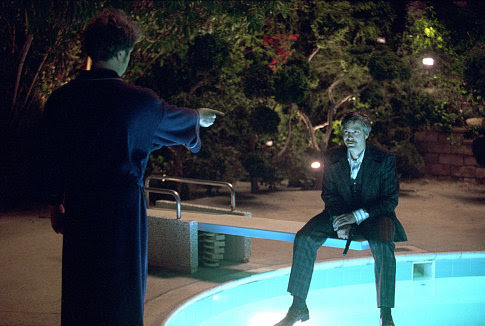
The Barris story's madness and what could be Clooney’s naivety behind the camera instead of in front of it allow the Ocean’s 11 star to deliver a film that is off the chain with visual “moments”. A Delightfully assured tracking shot has Barris touring the halls of NBC only to be the host of the same tour an instant later. Meanwhile briskly cold silhouettes situate the frosty European countries that the TV presenter must navigate to find his targets. When time allows Clooney slots, Rockwell, in front of mirrors to implicate the duplicity. That’s not when he’s having telephone calls meld into the same location or having C.I.A agents bleed artfully into swimming pools while sitting on diving boards.  A late sequence has Barris having a mental breakdown in front of an imagined slaughtered audience. A terrifying vision of a CIA hitman losing the plot? Or are we watching a deeply troubled producer seeing his brain-dead shows kill off the smarts of the audience? This is contrasted with an earlier scene in which a desperate Barris sits in a full auditorium glumly watching a movie while everyone around him is kissing. When Barris meets the free-spirited love interest Penny (An enjoyable Drew Barrymore), they’re seen necking in the theatre while everyone watches the movie intently. Seems that ol' Chuck never seems to fit in with the crowd. So why not envision them dead? It’s a moment which feels strangely apt for such a cracked mind. All this is delivered with a brightly lit retro colour palette and a wink to his usual collaborators. Blink and you’ll miss some friends of Clooney’s looking flummoxed on the dating game.

It's no surprise that it can all feel a bit much for some. Maybe a feeling of Clooney enjoying himself a copious amount. The film’s screenplay was written by Charlie Kauffman, the misanthropic creator of such gems as Synecdoche, New York (2008), and I’m Thinking of Ending Things (2020). Two incredibly cynical mind benders. Kauffman has stated his frustration with the finished film, with talk of a drug addiction subplot excised from the final film. Confessions is all a bit too sprightly for the dark trappings that inhabit most of Kaufman’s work. The screenwriter highlighted that this was more of a script on order, which had lounged in development hell for years than anything else. Jumping from director to director before finally landing on Clooney’s lap. As accomplished as Kaufman’s creations usually are, this is far from his more sardonic imaginings. And considering the grimness which inhabited I’m Thinking of Ending Things, that’s perhaps for the best.

Weirdly enough, Confessions still has enough Kaufman DNA inhabiting it to remind you of the scribe. This is a film about a self-loathing white male talent, wracked with self-doubt despite his success. This of course runs through the likes of Adaptation (2002) and Synecdoche, New York (2008). Although what’s perhaps lacking in this over the likes of films such as Being John Malkovich (1999), Eternal Sunshine of the Spotless Mind (2004), and Anomalisa (2015) is the element of communication breakdown between the film’s lead and everyone around them. If anything, Chuck Barris is a superb communicator. With the likes of Dick Clark leading the famous parade of known talking heads informing us of Chuck’s brilliance. Barris perhaps has too keen an ear on what the people want. His shows are not only still being observed in similar ways today, but also seem to be the type of “low culture trash” that can draw in huge crowds. The Gong Show feels no different from the most popular element of X-Factor. Praying on normal people who seek attention, despite maybe not having the inherent media talent for true success.

“…To mock some poor, lonely people who just crave a little attention in their lives. To destroy them. So everybody’s not brilliantly talented. They’re still people. They deserve respect and compassion. I mean, who the hell are you? What the fuck have you ever done that elevates you above the pathetic masses? Oh, I forgot, you created “The Dating Game”. Wow, right up there with the Sistine Chapel.”  - Pretty Woman

This quote is perhaps the most stinging moment of the film. And perhaps one of the most crucial. A withering blow to the strutting male ego. A beautiful, unknown woman dissecting Barris for what he is. Suddenly no matter how often we frequent Barris’ more dangerous alternative life, this woman’s burning critique feels seared onto Barris like a branded cow.  This is a man who wished he was more than what he became. Even when at the point of success, he is haunted by what could be considered imposter syndrome. George Clooney is interested in the moment where media & politics collide. But that truly comes later. In Confessions, this is the filmmaker going down a road well-travelled. That of a mad male talent and his demons. Is Barris telling the truth? The answer perhaps lies in how much you feel about appealing to the lowest common denominator and when you’re called out on it.  The film ends with perhaps one of my favourite quotes as the actual Barris is sat down, much like the docu-style talking heads from earlier. The lighting is harsh and bright. Blasting out any wrinkle or detail. The final moments are as earnest as they are depressing. Barris’ last quote is as follows:

"I came up with a new game-show idea recently. It's called The Old Game. You got three old guys with loaded guns onstage. They look back at their lives, see who they were, what they accomplished, how close they came to realizing their dreams. The winner is the one who doesn't blow his brains out. He gets a refrigerator."

I think it tells us all we need to know.


Confessions of a Dangerous Mind is on various streaming platforms. I dug out an old DVD.

Dug what you read? Buy me a Ko-fi!